Read full transcript
Welcome. This is Vincent for The Meaningful Sh!t Show with another episode today about the DBT skill effectiveness and how it can help you regulate your emotions. But hey, you say, we've already talked ad nauseum about regulating our emotions. Can we do this by now? You're right. We did discuss this very deeply and extensively in previous episodes, specifically the DBT skills, checking the facts, opposite action and problem solving.
But I have a little bit of a tweak to it that I think is short and very effective. Hence the name effectiveness. Just a quick recap on the checking the facts, opposite action and problem solving. And again, if you want more of a deep dive, go back to those episodes. But what DBT tells us or teaches us is instead of changing the emotions that tend to get us into trouble, to instead, whenever we are experiencing emotion and a strong emotion urge, so something that we want to do with that emotion, to really look at the prompting event, where did that emotion come from, to the best of our abilities to determine.
And can we strip away as much interpretation as possible from that? Right. So that we get to the raw event, the facts, and not our interpretations, and not our judgments and consequences that we attach to such a thing. We can then determine whether or not our emotion is justified or not justified, which of course is still a subjective call. Right. So you could, for example, see someone rolling your eyes at you.
That is sort of a fact. I mean, it's really hard to know absolutely for sure that someone rolled their eyes at you and meant to, right? Because if you're saying he or she rolled their eyes at me, you do not only mean the act of rolling one's eyes, but also sort of the emotional gravity behind that, what that means. Right? So it gets tricky. That gets tricky.
But still, based on all this context that you've observed and you try to go through that in the most objective way possible, you could determine, hey, my emotion is justified. I am angry and I should be angry, or I'm scared and I should be scared. The urge that comes with that, such as punching someone in the face or hiding, is an urge in the right direction. But using problem-solving, we then try to do that in the highest form possible, to not actually punch someone in the face, but to use skills to communicate our disagreement with something that happened, which should be more effective.
More about that later. On the opposite side, we have opposite action. If we determine, no, I'm nervous or I'm scared about the situation, but I ought not to be. What it teaches us is opposite action and good framework to take that emotion and act in an opposite way. What DBT, like the mindset or the philosophy behind DBT is, if you keep doing this over and over and over again, your emotional interpretation of event is going to change, right?
If you have an event that normally makes you scared, but you keep acting in opposite action, when you do that five, ten times, at one point, you're not going to be scared anymore. That's the principle. So they don't really address changing the emotion directly or breaking that down that much, but really changing the behavior first, and then the emotion will follow. At least that's the promise. So part of this skill, and it's the second step after checking the fact, is always determining if acting on your emotion is effective.
So it doesn't matter if you've determined that your emotion is justified or unjustified, which is already kind of interesting to me as a man with a technical background, like a background in programming. So if I see a decision tree, and step two is identical, I'm like, why have that step? Why is there a split? There's a little bit of a reason to that, but I go into that in the other episodes.
But now really focused on the effective, is acting on it effective. So I talked about effectiveness in that episode in kind of like a colloquial sense, just like, you know, if I talk to you as a person on the street, and I ask, hey, what's effective? You'll give me a definition, and that's kind of what we did. DBT has a specific effectiveness definition within the interpersonal effectiveness module, right?
So this is the module that's focused on people that have not only trouble regulating their emotions, but also collaborating with people, having successful interpersonal contact. DBT helps you with a number of skills. The effectiveness part is actually really, really useful, I think, and something that we can use to partially even bypass checking the facts and problem solving and opposite action in certain situations. And I'm going to break that down to you.
So first of all, we can see this effectiveness in context of having an action urge with another person, right? So it's similar to some of the situations I spoke about earlier. Someone says something, rolls your eyes at you, that's what I said. You have an action urge to become, to snap at them because you always do this or something like that. You never take me serious. Something along those lines.
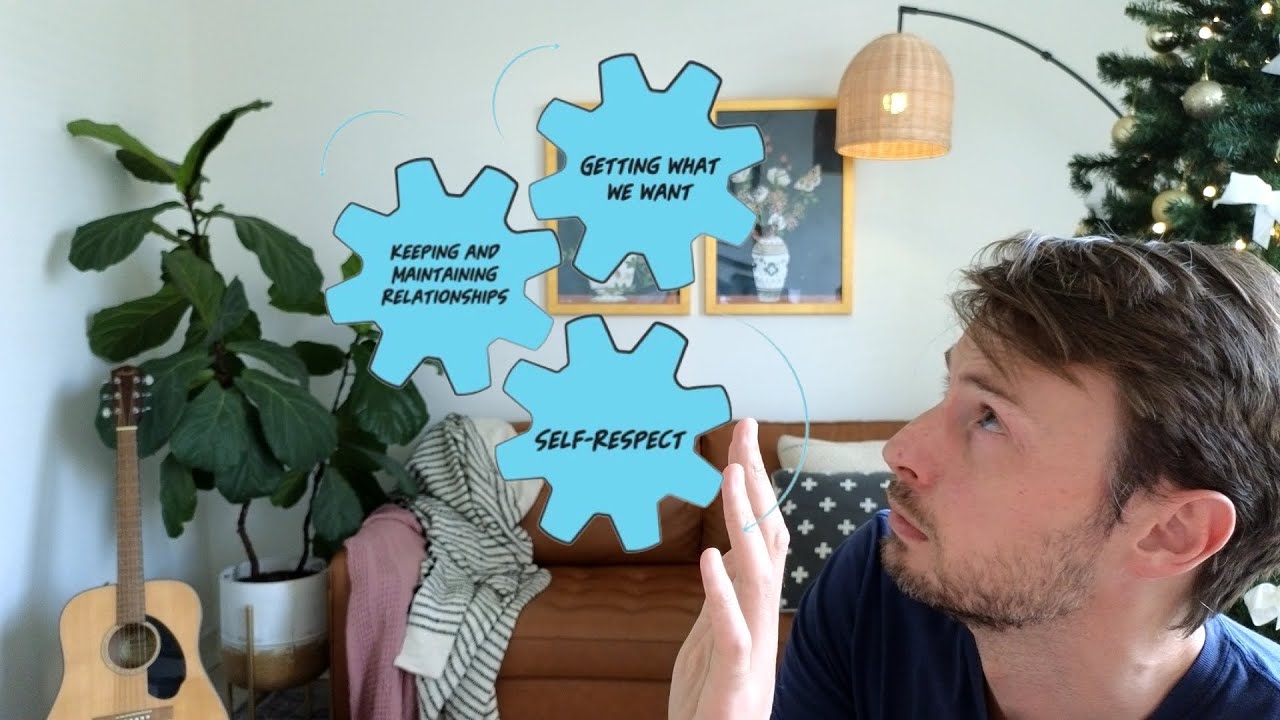
So we'll put it in that frame, right? So what DBT tells us here is to sort of pause and to take a look at what effectiveness looks like in this situation. And they talk about effectiveness having, like looking at it as a stool with three legs. So, stool with three legs. So ideally, you want to balance the three legs. It's not always possible. We'll find that out.
So first of all, your objective is effectiveness. This is just the most straightforward, egoic reason why you're in an interaction with a person to begin with. You're generally there to be heard, to get the person to do something for you, or to say no to someone that that person is asking you. Remember, in an interpersonal situation, you could have sought out that situation, but you could have just been involuntarily exposed to that situation as well.
So the second part is relationship effectiveness. So that means if you go in the situation and you act on your action urge, regardless if you meet your objectives or not, what's it going to do to the relationship? I'm going to break that down further with examples in a bit. Let's talk about the third one first, self-respect. So what is acting on my action or my emotion urge going to do in this situation, regardless if I get my objectives met, regardless of what happened to the relationship, how am I going to feel about myself?
Am I going to feel the same or better about myself or worse? Right. So there's more to be said about the skill, which I'm not going to do right now. I might do that in the future because DBT hands you specific skills how to really dial into meeting your objectives, meeting your relationship needs, and meeting your self-respect. But I'll just summarize them for mainly within context of what we're talking about here.
So self-respect, going to take them in reverse order, is in a way, of course, the most subjective, because what it means for me to retain my self-respect may look very much different from what my mother would think that retaining her self-respect would mean, or someone in the Middle East, or someone in China, or an alien in outer space, or a rock, or whatever. Getting a little esoteric now.
Right. So it has a lot to do with your values, your morals, your ethics. That's why I have an episode on morals and beliefs. Because the more clear you have, what are your values versus the values that society hands down to you, the better you can make these choices, right? So there are maybe some things that your society, your church, your group, whatever tells you is acceptable behavior, but you might still disagree with it and the other way around.
So the clearer you have that, like sort of on your retina, the better you can uphold this self-respect skill. But it's also, it can be like a little bit of a red herring, right? Especially if it comes to me. So personally for me, I can get the feeling that I'm like being pinched in my self-respect in some way, right? And what oftentimes happens is like the relationship effectiveness and the objective effectiveness kind of go out the window.
I don't really care about those anymore. I just want to make sure that I walk out of this interaction feeling like I haven't hurt my self-respect. And oftentimes when you get in that state, you can imagine that you're kind of like in a swamp and you keep sinking. So it's important to keep track of the other two. A little bit more about relationship effectiveness. So this is generally when you have an interaction with a person, it's someone you have a relationship with.
Not always, it can be a hotel clerk that can't find your reservation and is incompetent, and you could yell at them and get your objective met. Maybe not feel great about yourself, but maybe you don't give a fuck, and that's fine by your value system. But by and large, you're having interactions with people that you do want to retain a relationship with. They don't have to like you, but at the very least they should, quote unquote, ought to respect you.
That's oftentimes something that you want. It's going to be your father, mother, brother, sister, spouse, boss, co-worker, store clerk, etc. We're a social species. We don't like to not act in accordance to society. So that's an important thing as well. And then in the reverse order, getting back to objectives, effectiveness. I find this one is really, this is really interesting, because in any given interaction, there is like sort of a tacit objective, like you might not be completely aware of it.
But it's actually really interesting, because where does that objective come from? It sort of gets pushed to the forefront by what I would say is your ego, your selfishness, because you're in like sort of a real time interaction. You're not journaling or thinking about something, or speculating, or ruminating, or something like that. You're right there in a moment, and you can't go like, you know, think about that for like 10 minutes, and then respond, right?
That's not how conversations go. So there's a time pressure. You have to do this in real time. And in order to do things real time, we engage other parts of our brain that are a lot faster than our reasoning prefrontal cortex. So sometimes people talk about the lizard brain, for example. So we make a little bit more like messy distinctions, and a little bit more messy, selfish objectives sometimes enter the forefront.
So for example, you're in an, someone rolled their eyes at you. You are not even interested if that thing that they rolled their eyes at, if that was an eye-rollable offense in a way. The only thing that you're aware of, like your objective of wanting to be hurt, be taken seriously, whether or not the point that you just made deserves to be taken seriously or not. You could have said something really silly or dumb or insensitive or something like that.
That is possible. But you're in a real-time situation, and you don't always have that ability to distinguish that. So although this skill, looking at objectives, relationship, and self-respect still takes time, right? It's still something that you might have like sort of a pause for like five, 10 seconds where you think about that, but that's still more or less within the bounds of social respectable behavior. Maybe not if you're interacting with a store clerk, they're waiting for your credit card, but even then, if you pause for like five seconds, that's also going to be fine.
So you're kind of like in the clear there. So what the goal in a way of how I look at effectiveness is, like I said before, to see it as a stool with three legs. And if you can balance things out, that you can actually sit on the thing, you know, maybe one of the legs is shorter than the other leg, or something like that, that's fine.
But balance the three goals in some way, then you're good. And of course, this is very much like a metaphor, and it's very much dependent on like your values, right? But what we're trying to prevent here is that everything goes towards your objectives, and you forget about the relationship or self-respect, because you're not going to get into a comfortable situation afterwards. So that's really what I'm focused on here.
So let me go through a couple of more examples to hopefully help this come alive a little bit more. And I'm going to call out some specific examples that we'll get to why I chose the examples that I did. So let's say you're sitting in a situation and you didn't get a raise. Other people did, but you didn't. You're pissed off about that because you feel like you deserve that or something like that, right?
And you have an action urge, and depending on your personality, that might be yelling to your boss or crying. Let's say that you do that and you get the raise. Like you go to your boss, you act out emotionally and they're like, Oh, well, yeah, shit. Yeah, actually, you do deserve that raise. There you go. There's that raise. So the reason that I'm giving like a positive outcome in the sense of your objective being being mad is because if your objective is not being mad, it's not as subtle of an example.
I could have made this example as well as like you didn't get a raise. You went into your boss's office and you punched him in the face and you get fired. Then it's very clear that there's something off. That's primarily the focus that activity exists if you're completely emotionally dysregulated. But I want to tune in to a little bit more like the situations where actually you're getting your objectives met, which might still not be exactly the outcome that you would want to achieve.
Right. So the fact that you didn't get your raise doesn't necessarily tell you what to do. Right. That has a lot to do with, I mean, the effectiveness again. So first of all, there is an immediate objective that comes with it, which is like how you want to raise as well. I mean, that's partially like baked into this example right now, but you can imagine that. But you can also see that it's a very selfish reactive objective.
Right. Did you really think that through? Did you really think that whether or not you deserve that raise? Maybe you didn't. Maybe your co-workers worked harder. Maybe you're in a department that etc. Depends, right? So the relationship with your boss is also important. So arguably, having a good relationship with your boss might be more important than hell or high water getting that raise, right? And you might get that raise, but your boss might respect you less.
You know, so it's something to add to the equation. As well as self-respect, if you've ever been in a situation where you got angry at a customer service person, and they are obligated to help you, but you just turn into a dick, you got what you want, but then you hung up and you were like, ah, that wasn't really great. I have, and I don't like to do that anymore.
I actually try to focus a lot on these people in customer service kind of jobs, they have it hard enough, right? So they deserve some kindness, I think. And generally, that also gets me to meet my objective better, but that's kind of beside the point here. So, excellent. So that was one example. How about a more personal example, in the sense of not work, but a personal situation?
Let's say that your spouse gets upset with you. And I mean, we can drag in the exact same eye-rolling situation, or she criticizes you. And when you check the facts, if you would do that, you still feel like the fact that you feel insulted about that is justified. But the fact that you're upset and that you feel that your right to be upset doesn't really tell you what to do yet.
That's the additional extra step that comes afterwards. Your knee-jerk might be to avoid and isolate. For a lot of men, that's what we like to do if we're emotionally hurt. You might want to get drunk and get high. You might want to watch some porn and jerk off and feel better. Watch Netflix, just numb out. That might be effective because at that moment, the moment that your spouse upsets you, actually your tacit objective is not feeling the pain.
I just don't want to feel that pain. So your objective in that situation is met. And actually, when you act out in that way, maybe not in every way that I've just pictured, or expressed, I should say. Maybe not each situation, but if you just isolate yourself, you might still actually get what you want, your higher goal, which might be a connection with your partner.
But they might do that for you because they see that you avoid and isolate, and then they go, okay, baby, what's wrong? And so that makes them do the hard work. And you still get what you want in this situation, but you did go against the relationship. You did go for an objective that's not really that important, right? Feeling good or not feeling this feeling. That objective is not a very high quality objective.
You went against the relationship, you hurt the relationship, it might be repairable, but still. And I bet that your self-respect is also not really in the place where you want to want to be. Because if you just, you know, honestly act like a child, avoid and isolate or get drunk or something like that, that's not high quality adult behavior, probably. And you might have various excuses because you compare yourself to your friends and they do it as well.
And when you grew up, your dad was way worse. And I saw the neighbor doing this thing the other day. And I'm actually a pretty respectable, well-likable guy. All of that might still apply, but we're not here to meet other people's standards. We're there to meet our own standards. And that's where having like self-respect, your values, your beliefs mapped out well, becomes incredibly important. So what my takeaway is, is that this skill is very important because it cuts out even the necessity sometimes to check the facts.
Whether or not your spouse rolled their eyes at you, doesn't really ultimately matter because from a self-respect perspective and the fact that you value that relationship, you still want to act in the same way. My takeaway is oftentimes these objectives, these selfish objectives that get thrown up in real time, they are not that important. They often are not, right? They're just the thing that your ego does.
So when you apply this framework, you will see that these objectives are mostly not really that important if you compare it to the consequence, like how effective you are of retaining your relationship and self-respect, and if you weigh that against your objectives. Usually, you can negotiate the objective with yourself, right? That's oftentimes possible. oftentimes, you can replace the objective with a better objective. Let's take that example of not getting the raise.
Instead of bitching and moaning until you get that raise in that way, why don't you go look for another job? I mean, of course, not explained a lot about this context of that situation. So whether or not that's the appropriate step, that remains to be seen. But that could be a more high-quality objective that actually can make the retention of the relationship with your boss important, because you might need them for a reference, and might be great for your self-respect as well.
So the effectiveness really, really helps you question these objectives, these tacit objectives that you have. And most of these things that you're engaging with are actually just a distraction. If you pause, turn inwards, and look at what you're doing, they're a distraction. They're just your patterns happening over and over again. This is why I like to quote, "Awareness alone can be curative." If you can muster the focus, in a moment like that, to really stop and look at what you're doing, even if you're still going to do that, right?
You might have to do this a couple of times to understand what's going on before. Slowly, you can go and change things. But I think that is a very, very powerful principle and practice. All right. Thanks for tuning in. This has been Vincent for The Meaningful Sh!t Show. I will see you next time. Thanks so much. Bye.