Read full transcript
Hello, hello, everybody. Welcome to another episode of The Meaningful Sh!t Show with me, Vincent. Today, we are going to talk about the polyvagal theory, and really the sympathetic nervous system, the parasympathetic nervous system. So we're going to talk about how all of that is wired, what the polyvagal theory is, and actually how it relates to the emotion regulation in topics that we've been talking about. So why am I talking about that?
First of all, for personal reasons. I am definitely on the anxious side of the spectrum. I'm often in like sort of like a flight mode, like kind of, you know, activated. And learning about polyvagal theory, in addition to DBT, helped me in my life from problem-solving, from individual problems that I was dealing with, because often you're anxious about something, and then, you know, actually solving the problem makes sense, to also radically accepting where I was at a moment, and having an understanding of my nervous system activation, and what I could and could not expect from myself.
I've also suffered from using maladaptive coping strategies to deal with that anxiety or depression at times, to get out of stress as well. And the maladaptive parts, of course, had negative consequences. So I'm here to share you, share some of the lessons that I have learned from polyvagal theory at large. And that really today helped me to become a better person. I've also been hearing references to it a lot lately in popular media.
And I had a curiosity as well as how that plugs into the DBT emotion regulation skills that we've been talking about. And now I'm here about to share it with you today. And as a feed forward, I do think it's a very useful theory. But first things first, let's talk about what the vagus nerve is. So the vagus nerve is part of the parasympathetic nervous system, the PNS, which is also dubbed rest and digest or tend and befriend.
Although there's numerous other nerves in the system, this one reaches the majority of the body's organs. It is the longest cranial nerve that we actually have. Vagus means wanderer, and that has something to do with the fact that that nerve like wanders all over your body in contrast to the sympathetic nervous system that's much more like sort of a start pattern. Goes through the spinal cord and from the spinal cord, branches like sort of directly to your torso, where the vagus nerve like splits off of the spinal cord around your neck and wanders all over the body visiting all these organs.
So it is the opposite of your sympathetic nervous system as you guys might have heard about, that's the fight or flight gets you going. And para actually means again, so they regulate each other, they influence each other. Together, they make up your autonomic nervous system. So involuntary body activities, breathing, beating your heart, things like that. And 80 to 90 percent of the nerve fibers in the vagus nerve are dedicated to like signals going up.
So our brain getting information on the state of the organs. But of course, the brain also influences the organs. More about that later. The vagus nerve has two branches. We have the dorsal branch, the back. It regulates all the organs below the diaphragm. And the ventral nerve, which is the front, which affects everything above the diaphragm. So think of the muscles of the face, the heart, the lungs.
So a lot of these parts are used to interact with others. I've already referenced the sympathetic nervous system. So it's a network of nerves that helps your body activate its fight or flight response. It increases when you're stressed, when you're in danger, or just generally physically active. Its effects include increasing your heart rate, your breathing ability, your eyesight, and slowing down processes like digestion. Nobody got time to digest when you're exercising, when you're running from a predator.
So both of these descriptions that I've talked about, they are from the Cleveland Clinic. That's why I got the majority of the description of just like the physicality of the nerves. I kind of have to cut myself up because there's so much more. There's the central nervous system, there's the limbic system. Of course, everything influences each other, but we're going to try to focus and stay with the autonomic nervous system as much as possible.
I have a visualization of that, and if you're listening to that, instead of looking at the video material, that's not very helpful, but I'll do my best to describe it. So it's basically a schematic overview of the parasympathetic nervous system and the sympathetic nervous system, and how it regulates or influences the different organs that we have. So some of the things that the sympathetic nervous system, the fight or flight does, is dilate pupils, inhibit salivation, relax airways, increase heartbeat, inhibit activity of stomach.
We talked about that. Stimulate release of glucose, inhibit the gallbladder, inhibit activity of intestines, secrete, gosh, epinephrine, and well, words that I don't know. Something with the kidneys relax the bladder and actually promote ejaculation and vaginal contraction. So this whole sympathetic nervous system ties into our genitals as well, which I was surprised to learn. On the parasympathetic side, a lot of the things that it influences is opposite.
So it's constricting the pupils, stimulating saliva, constricting the airways, slowing the heartbeat, stimulating activities of the stomach, urine rest and digest, stimulate activity of the intestines, contract the bladder, and promote erection of genitalia. Also interesting. So that's associated with the parasympathetic nervous system. Again, the rest and digest or tend and befriend. So, so far, I've really talked mostly about the physicality of the nerves, the fact that they're in our body, where they are, which organs they reach.
Stephen Porges, in 1979, coined the polyvagal theory, which goes a little bit more in our evolutionary history, looks at some of our ancestors, and comes up with a description, a theory of how this all came to be, and why it works in that way. So again, our focus here, that, or I want to highlight a couple of more things about the vagus nerve. Remember that I said we have the dorsal branch, which is the back and the ventral branch, that's the front.
So the dorsal branch, the back, from an evolutionary standpoint, it's much older. It's a much older part of the nervous system. Of course, these things, it's not a clean cut thing that that side first developed, and then the front side did, but the roots of the dorsal vagal pathway lie with our reptilian ancestor. And more about why that's relevant later. So it's instrumental in activating the shutdown of the body.
As we can see when overwhelming trauma happens, and it's oftentimes people that have had overwhelming trauma when they get PTSD, post-traumatic stress disorder, they get back into freeze mode, although it might not be appropriate at that moment, like they're not actually in a war at that moment. It's just a firework show. Right? But your nervous system doesn't quite know that, puts you back in the same state.
I'll tell more about that shutdown in a little bit. Then we have the ventral branch, which is the front. From an evolutionary standpoint, much more recent, and some sources say it's unique to mammals. Like if you dig a little bit deeper, it's unique to mammals because in reptilians, like we call the system something else. So take that with a grain of salt. But there are some mammalian characteristics that are interesting and that have a lot to do with social engagement.
Remember that I mentioned a lot of the ventral branch, the front, connects to our facial muscles, which are instrumental in communicating our emotions. We talked about that in the Emotion Regulation episodes. So according to Dr. Porges, social engagement in turn tends to downregulate. So calm, the sympathetic nervous system, and the fight response. So when we experience our environment as safe, we operate from this social engagement system.
Remember what I said is that that nerve 80 to 90 percent is like upstream, communicating state of the organs to the brain, but it regulates from the brain downwards as well. So it's kind of interesting that both influence each other. There's not like one master and one worker. It's not that the organs are responding and doing anything that the brain says. It's not that the brain does what organs say.
It's one of these situations where you can stimulate these nerve pathways by reasoning from the brain, because you have influence there, but you can do it from your organs as well, which in fight or flight is, for example, starting to move your body, right? Just puts you in a fight or flight state just by doing physical exercise. More about that later. So I alluded to this already, that polyvagal theory states that our emotional states coincide with the activation of certain nerve system, physical nerve system branches in our body.
When we're resting and digesting, our ventral branch is most active, and as our limbic system finds it appropriate to escalate, the sympathetic nervous system fires up. And if all that fails, your dorsal vagal takes over again, you get into freeze mode, and we can strategically do things with that knowledge. I do want to highlight, it's a theory. It also means that it's not as clear cut as I make it sound.
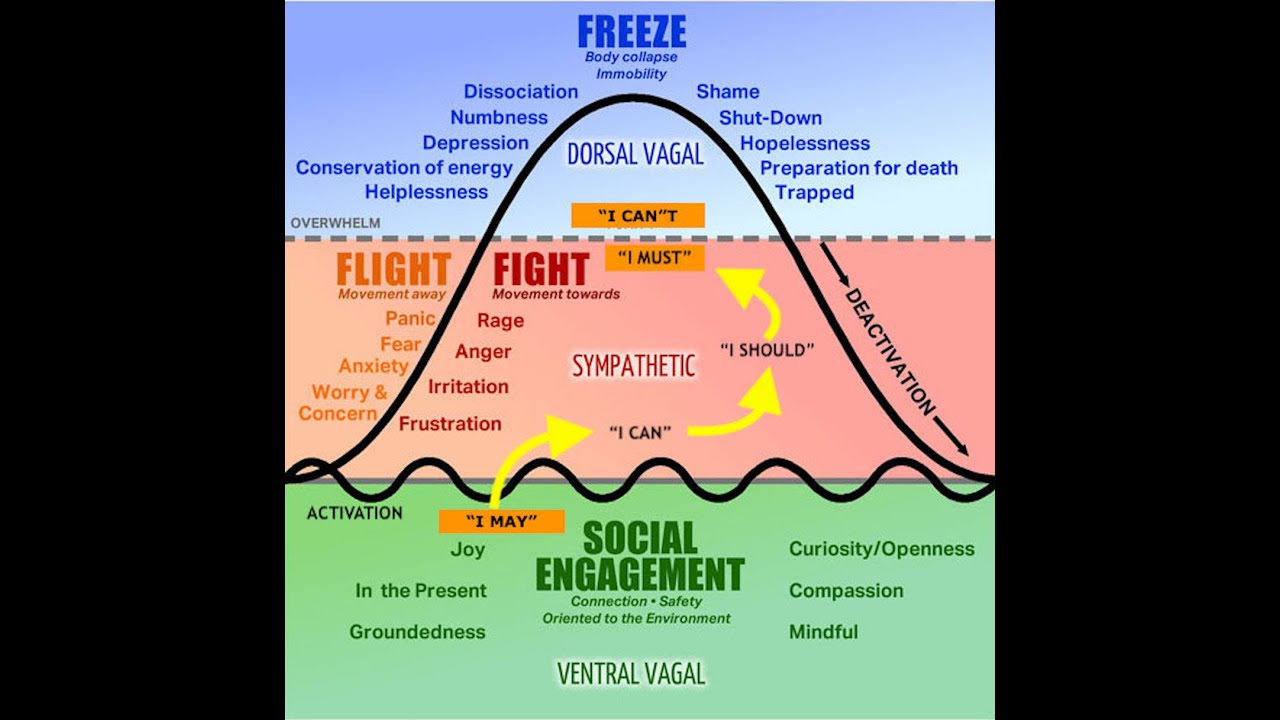
It's not that you can like, you kind of like digitally switch over from system to system. That's not quite it. It's a little bit more fluid than that, but as an abstraction, it's helpful and useful. So let's take a look at how to think about it in a number of different ways. Again, if you're looking at the video material, I'll put up a schematic of that or like a chart.
And for those who are listening to that, I'll be sure to talk through it, which I'm going to do now. So when you're looking at these three different, like branches, nerve systems, basically, I already alluded to the fact you can divide them in social engagement, sympathetic, which is fire flight, and dorsal vagal, which is freeze, right? So there's a couple of things that are interesting about this.
So first of all, to think about when you're, for example, ventral vagal in social engagement mode, how does that look, how does that feel? Because that mode comes with certain advantages, certain things that you can do because you're not stressed. In a way, you're the most present, you're the most composed, you're in your comfort zone, you're regulated. So words that can be associated or emotional states are things like joy.
Mind you, it's not joy in a form of ecstatic and excitement, it's a baseline joy, right? In the present, grounded, curious, or open, compassionate, and mindful. So you're connected, you're safe, you're oriented to the environment. You're not in, you know, your survival is not being threatened. You, from a perspective of being motivated to do things, you're a little bit more in, like, I may mode. I may do that, I may, but you're not experiencing any type of, like, sort of coercion by yourself.
You're really relaxed. Oh, I might eat something, you know. I might watch something. From the ventral vagal, so the social engagement system, generally what happens when we activate, so there's an activation that generally puts us into fight or flight when we get activated. You can theoretically straight go from social engagement into freeze mode. That is possible. And although oftentimes people talk about that it's a ladder, it's also like you can, you can get to the top of the ladder by, by leaving the bottom of the screen or however you want to think about it.
But, but generally, this is again, in general, you get to that freeze state through the fight or flight state when that, when that fails. But let me, let me talk about that a little bit more. Okay. So when do you get activated? When does your fight and flight system activate? So there's a bunch of different reasons and I'm going to give you a list later. So from more of the scope of like, what kind of emotions are associated with that is generally worry and concern, which escalates to anxiety, which escalates to fear, which escalates to panic, right?
So that's a flight. That's a movement away. And then on the other side, on the fight side, you have frustration, which escalates to irritation, to anger, to rage, right? Where you're more fighting, moving towards. So both of them are mobilizing though, right? Your body gets into a state that it can do stuff. So I mentioned before in social engagement mode, right? And when you're in the ventral vagal, you're a little like sort of in I may mode.
But the moment that you get in fight or flight, it, you know, your motivations or they constrict. So instead of being like, well, I may, it more goes towards I can, like really feeling like this is something that's possible for me. To I should, you know, constructing even more, to I must. So if you're like fully activated, and maybe you have examples in your personal life. Doing the thing doesn't feel voluntary even.
Doesn't matter what it is. And again, I'll have more examples later, but it feels like you have to. So that's of course a strategy that by fighting or flighting should get you in a state that you can return to that social engagement. And in a way, this is very important to us as biological creatures, that we are in the social engagement, rest and digest state, but we have to be in fight or flight as well.
That's part of our survival, right? At one point, flight and fight or flight can run out of usefulness. So that's when we get to overwhelm. So in this visualization, it's all the way of the top of the chart. So we keep activating, keep activating until we get into freeze mode. That's when your body collapses, your pain sensitivity goes down, you immobilize again, right? So you went from social engagement, which is safe immobilization, to the sympathetic nervous system where you immobilize, you fight, to a state, in this case, if the threat continues where you shut down, you're overwhelmed, you feign death in a way.
And that is, if you look at the animal kingdom, a strategy that sometimes works. Because if a prey suddenly stops behaving like prey, that can mean that they survive. There are examples of that. If the predator is not properly motivated, isn't that hungry? If a prey stops acting like prey, that can actually save its life. But it's not just about that physical safety. Words that are associated, emotional states that are associated with the free state or helplessness, conservation of energy, you might need it later when you actually can like fight or flight again.
Depression, so that more like the emotional side of that. Numbness, dissociation, shame, shut down hopelessness, preparation for death, and feeling of being trapped. So you're very much in an I can state. When you're in freeze, there seem to be no options for you. Oftentimes, it's like I mentioned before, it's associated with hopelessness. So this is really where depression comes in, right? You're kind of like in bad and you feel like you can't even get out.
It feels like everything you're moving through molasses. That's not actually true. Your body is perfectly capable of doing it. But for those who have experienced that, it's pretty dang powerful, right? Cool. So from freeze, you can get out of freeze in various different ways. So it's not a healthy place to be. For our nervous system, that is really when we're close to death, right? So where fight or flight and social engagement, of course, are stages that we want to be in.
If we want to be healthy, we have to plan and add those in our life at good intervals. More about that later. Freeze mode is something that we generally want to avoid. Whenever we're in freeze mode, we want to implement things that get us out of that. And I have a bunch of practical tips for that. Some of you might have heard of fawn as well. Fawn is something else.
It's more of an appeasement tactic. You can fawn from any state. So when you're frozen, you might appease a person to stay safer, but you might do that technically in fight or flight, although it's a little bit less likely, but from rest and digest as well. So it doesn't really map to this polyvagal theory. It's not part of it. I have some examples to make it come alive a little bit.
Imagine being relaxed at home. You're engaging in a relaxing activity. Maybe you're reading a book, you're watching TV, playing a game, you're in rest and digest state. Suddenly, you hear a large crash outside of your house. What immediately triggers is the fight or flight response, and that can fire up in milliseconds. Your heart rate go through the roof, you become alert, your body prepares for potential danger.
If you then determine that the crash was caused by a harmless event, maybe a falling tree branch, the physiological response may return to a resting state pretty quickly. But however, if there is an imminent threat, if there is an intruder, the response might actually escalate to more mobilization. So that's the standard sort of example, straight forward example, being from like an regulated state to fight or flight, that might be required, right?
Where you actually have to fight off an assailant, or you quickly return back to a rest and digest state. So that's healthy to go through, as an organism that needs to survive in this world. That makes sense. Let's look at it from a slightly different angle. Let's say that we have a confrontation with an aggressive individual. So you might have started engaging with this individual from a rest and digest state, but as the argument escalates, and you see the body language of that person, you immediately become aware of that, and you match.
You sort of go activate together. They're angry. You're going to be angry. Depending a little bit on your template, you might not actually become angry. You might more go towards the panic state where you want to run away. But that depends. As this escalates, like people go activate together. The more angry that person get, maybe the more angry you get, or the more panicky you get. And both of these parties see that.
So they experience increased heart rate, adrenaline surge, and the readiness to defend themselves or flee the situation. Right? Same situation can happen here. That can be like sort of a confrontation. Confrontation then leads to sort of like that climax or a fight or a flight. But an altercation like that always has like some kind of like natural, natural end, right? You might get into a fight, like let's say that's a bar fight or something like that.
Then you stay activated for a while until you return home. And that's where you get back in rest and digest state. But this is an example where fight or flight can take a very long time. How about witnessing a car accident? That's even if you're not in it. Again, you can get there from a rest and digest state. You're just chilling. But the sudden impact and chaos can trigger your sympathetic nervous system.
So you get in fight or flight. Again, you get that adrenaline rush, the increased alertness, the urge to help or seek safety, the urge to help. And maybe you have that feeling in your own personal experience as well. That's when something stressful like that happens. There is something that goes and looks out for other people. Like if you're sort of in a rest and digest state, you might not as be inclined to help people up if something happened out in the world.
Like a car crash or something like that. And that's because fight or flight mobilizes you, compels you to action. If the traumatic event continues or becomes overwhelming, you actually might shift into an immobilization response. Right? So that can involve getting more dissociated, feeling numb, or even a temporary loss of consciousness. And often what's associated with this as well is memory loss. You can hardly even remember that that happened.
And that's true because you actually don't have access to some of the systems that you normally have. It literally shuts down. How about if you're a victim of some kind of assault? Let's say that you're pinned down in some way and you see that fighting or fleeing is not a possibility. So we're looking at this from a freeze mode. So freeze mode often activates when you see that you're going to be physically overpowered by this assailant.
Like you could initially get in that state of wanting to fight that person. But if you realize that they've got you overpowered, even pinned down, or if like sort of time progresses, you can get in freeze mode. If you have had a history of assault, where generally you haven't been able to get out of it by fighting, guess what happens? You switch into freeze mode much more, much easier.
And this is one of the parts where freeze mode is something that, from a PTSD perspective, people focus on a lot. It almost bypasses your fight and flight. You immediately go into shut down into life preservation mode. In this situation, even the people that have PTSD, the moment that the situation lets up, the moment that you see that you have ability to escape, to catch your assailant off guard, you can suddenly get a huge burst of energy.
Escape through a window, run a species you did not think you were capable of. So then you're in sort of like this interesting combination of a freeze response which like escalates back into fight or flight. So part of the reason that you shut down is to conserve energy. So if you have to fight or flight again, you have something available. Right. That's one of the advantages as well that your fight or flight system can activate really quickly.
Whether or not you're immobilized from a rest and digest, or if you're immobilized from being in freeze mode, it can be really important to quickly fire up when opportunity strikes. I mentioned before as well that rest and digest have something to do with sex. So it actually prepares your genitals for intimacy. I'm talking lubrication and erections here. And that can be actually good to remember as you initiate sex.
You want to do that from a rest or digest state. That's what your nervous system likes the most. So as we actually start having sex, some of it includes foreplay that's associated with, guess what, you're not resting anymore by and large. You're actually, you know, your heart rate goes up. It's like physical exercise. In some situation, it's actually a little bit like fight as well. It can be like sort of if you think about what sex is, that you're just penetrating someone's body, it's kind of an aggressive act as well.
So there's definitely some fight, not just physical exercise. And more about that later because that can lead to a freeze response, of course, as well. When we're more in fight, orgasm is actually promoted, which is also good to remember, that if you're trying to be sexual with your partner, and for you to both experience an orgasm, that that's like the state that you want to be in.
If one of the two is in a freeze mode, that's not really conducive to actually having an orgasm. What's really interesting about sex and getting into a fight or flight from that perspective is the moment that you do get that orgasm, there is a super powerful hormonal boost back into social engagement, which is, there's a lot of oxytocin that's released in that way, which is the bonding molecule, and it calms you down really quick as well.
So it's really interesting. More about oxytocin later. And also be aware how strong of a cocktail that is, and that it's important that you actually use that to bond to someone. I mean, I'm not saying that every time you have sex with someone, that needs to be someone that you want bond with, or if you're masturbating, of course, you get that cocktail of bonding molecules, but you have no one to bond with.
I'm not saying that that's wrong in all situations. But do be aware how sex is wired into our nervous systems and how it's supposed to work, and use that to your advantage. It behooves you to align yourself in the direction that things are laid out for you. It's what they call wu-wei, cutting with the grain. Because if you are trying to do something, in this case with sexuality, which is not really in line with wise, evolutionary part of our templates, it might have negative consequences for you.
That you're not looking for. Do want to touch on this as well, is that anyone who has experienced sexual trauma can actually get in that freeze mode really quickly. And you can imagine why females are, especially for females, they're usually in a vulnerable position. And fighting and flight in a situation like that is not terribly helpful from being physically overpowered, but also from a social perspective. That's not what women get taught to do, right?
That's not, if you look at porn, what a woman that is like sort of the receiver of some kind of like threat or violence does. No, they get more submissive. So, but that doesn't mean that they're having a good time. That means that they're in freeze mode and they're trying to survive. So that's really important to be aware of as you're engaging sexually with partners, being aware that they can slip into freezing, and that the point of freeze mode is that you don't see it.
The assailant, even though I'm not saying that you're raping someone in that situation, but that's how it can feel for that person, you can still slip into a freeze response and not be aware that the partner is in a freeze response. So that's good to be aware of if you want to not discover that later. And I've experienced that both actively and passively, as in I've slipped in freeze mode during sexual encounters, and I've learned afterwards that partners of mine have done that.
It requires a lot of communication. And knowing about all these different nervous system states, I actually found useful to think about it in that way, because in a freeze state, you just don't have everything available to you that you normally would have. Cool. Okay. Let's go through one more example. That's more like the extreme terrible example. Something terrible and unexpected happens. There's a death in the family.
There's financial ruin. You lose your job. Society collapses or your sport team loses. All things that are extreme, extreme dramas. You cheat on your spouse or your spouse cheats on you. That situation can quickly lead to a state of depression, of grief, of dissociation, of numbness. So you are in that dorsal vagal system. You're depressed, you're sad, you can hardly get out of bed. Life feels meaningless. You might even have suicidal thoughts.
But how do we get out of that? So if we are in a state like that, if there, let's say that there's a person, a friendly person that's engaging with you, they've heard about what happens, they have a conversation with you, they respond to you compassionately, empathically. What you do then is you slowly co-regulate, right? There's something in like the mirror neurons where we humans, we co-regulate with different humans.
In that example where you were having an argument, you escalate up, but you can also calm down together. So as you co-regulate, you ground together, you get back into a rest and digest state, and you get more access to those feelings of grief. That might mean that you slip back into that freeze response because it's too much. Remember, that's where the freeze response is for, for emotional, shutting off emotional pain as well.
But you can repeat this over and over. And if you look at the different stages of grief, that can be mapped to some of these nervous system states as well. But I'll leave that, I won't go into detail, maybe in a future episode. I want to re-underline that it's not binary, it's not digital. It's not that you, you know, shift gears, as in you're in one state, and now you're in a different state, and you're completely not in the previous state anymore, as in I'm only in fight or flight.
They're gradual. Like, there can still be elements of rest and digest that are present, but the majority of your nervous system is in fight or flight. It's not an on-off switch. So from that perspective, it can also be like a little sort of messy of like, am I really just shut down in freeze mode, or am I resting and digesting? Because they're both like an immobilization state, so they are similar in some situations.
So there's some overlap where, you know, it could be from the rest and digest system, it could be from the freeze is what I'm saying. So it's not digital. It could be both. So let's go into insights that I think are very important, and I've alluded to some of them already. It's important to acknowledge that we're fucked if we're in the wrong state, because we have tools that we can't use.
If you're trying to go to a McDonald's drive-thru with a tank, you're not going to be very successful, but it's great if you want to blow up your enemy. If you're trying to write a poem with boxing gloves on, good luck, but you can use those boxing gloves very well to kick the shit out of your enemy. And if your heart is racing and you're trying to sit calmly and listen to your partner, that's not going to go very well, but it does allow you to run out the door and hide, for example.
Or you're trying to run, but your shoelaces are tied together. It's not going to help very well. It's more appropriate to actually stay put and assess the situation. So these are all examples to underline that we can slip into a state that gives us the tools that we actually don't need. And it's the tools that your nervous system thinks you need. So from a PTSD perspective as well, you're at a firework show and you just hit the deck because you think you're under fire, under enemy fire.
That is not actually the tools that you need, but your nervous system doesn't know that. Your nervous system is not all-knowing and not susceptible to misprogramming. A lot of the template gets laid down when you're like zero to seven years old, but traumatic experience can change that, although it more influences some people than other people. Like PTSD doesn't develop in everybody, which is interesting by itself. It could mean for you that your templates compels you to shut down too much.
You got taught in childhood that it's just better to freeze. Better to dissociate to deal with the pain because you were being abused or whatever was going on for you, but it was just too painful to engage with that. It might also mean that you fight too much because that was your survival strategy that worked for you. Or maybe even that you rest and digest too much, which means that you're just in a passive state, in a well, I may state, a laissez-faire state more than you want to be because that was rewarded by your environment.
How would you ever know that you're too much in one state or another state? It's really introspection, contemplation, and feedback from the world, right? You want to check that with your own values, with your own beliefs, going back to the episodes that I have on that, because maybe it is within your value to fight everything. Maybe that is very important for you, and you might get feedback from people with like, oh, dude, you fight these things too hard, just like mellow out.
But you can still, from your values perspective, be like, no, this is how I want to be, and this is effective to me for these reasons, right? It can be personal preference. There is no cookie cutter here. What is important is that introspection, because generally you do that from a mindset of wanting to be effective. The moment that you're really fighty, it does allow you to get some things in life, but it prevents you from getting other things in life.
So it's important to use the check the fact skills that we talked about before. Is my emotional reaction the reaction that I want to be putting energy into? And acknowledging that it's a personal preference. So the fact that you go into fight, but your friend over there stays in rest and digest, that doesn't mean that you're wrong or he's wrong or, you know, it means that there's two different personal preferences.
Don't kid yourself about there being a right. Realize that there's no right and realize that it's up to your preferences. So don't look like ask someone. You can take feedback. Don't get me wrong. But don't accept that as absolute truth. There's work for you to determine where do you want to be. There is socially acceptable, right? What's socially acceptable for a woman is different on what's socially acceptable for a man.
Don't let that limit you too much. But there's also social acceptable from a perspective of, if you do certain things, you get thrown in jail. That might be more important to pay attention to. Like if you get in bar fights all the time, at one point, that's going to have, that's going to leave you incarcerated, right? So that's why introspection is important to see, is this emotional reactivity that I have, is it really doing for me what I want it to do?
Although it might feel appropriate to be angry, because remember, that's what these nervous system states do. It makes you feel like you're having the correct emotion. What's important to realize is that changing your environment only works short-term. Your mind-body will go for a physiological homeostasis, so it will adjust to the new surroundings, but your template, without going into that with conscious effort, will remain the same. In short-term, it helps.
Like let's say that you get out of an abusive relationship. Short-term, first couple of weeks or months, you're not going to experience the same cycle again. But quickly enough, you will get into a situation, either get in a situation again or recognize a situation in such a way that you get back into your pattern. So there is something that needs to be done to not repeat these patterns, both from a perspective of getting in a situation where the pattern is appropriate, right?
Because in a way, our nervous system wants to be useful. So the moment that you have to get in a fight mode with a new partner that you're having, from one perspective, it's like your nervous system likes that because it knows what to do. Right? So it's both getting in an actual situation that calls for being in that state, but also for letting your nervous system turn the situation into that.
So let's say that you're in a new relationship, and actually this partner you don't have to get into a fight state with. You can stay and rest and digest together, but your pattern is to go into fight. And because we co-escalate, you might pull that person into getting into a fight state as well. And then you're actively not just reliving or reenacting your situation by choosing the wrong partner.
You're actually changing the partner into the partner that you don't want. Be aware. See your patterns with the power of awareness. So what do you do in these situations? Like how do you actually see these patterns and interact with them? So I have to caveat that with if you're not in a life-threatening circumstance. If you're in a life-threatening circumstance, do whatever to get you safe. I mean, should be obvious, but I've sort of devised like three steps here.
So step one is honor your template with awareness. So whatever your emotional activation state is, don't change anything right away. So accept your coping strategy to get out of that emotional state or stay in that emotion or whatever it is. Don't hide from shame or guilt. Allow yourself to truly feel it. See the consequences, but also the benefits like why am I doing? Why am I getting angry?
Why am I getting in that bar fight? See the bad things, but also the benefits. Be aware of that. Overeating. Why am I overeating? What are the benefits? What are the downsides? Why do you do it? But don't change anything. Don't immediately change things because that's going to mess with your measurement, right? You've gone through this pattern many times. You can go through it one more time, but with awareness.
Welcome it. Be curious. The dark thought, the shame, the malice, meet them at the door laughing and invite them in, which is from our Rumi poem. But I think that that applies to this as well. Everything is just accepted. There's curiosity towards everything. You're not changing it. You're not judging it. Step two, once you're in a rest and digest state, and I have more tips of getting back into a rest and digest state later.
Once you know your patterns, examples being maybe taking the edge off with alcohol, then getting into bar fights, overeating, or just having sex fucking through anger in a way. It's like not dealing with your anger, but using sex to downregulate, to rest and digest. It's the described skill in DBT, by the way, as well. So the moment that you know your patterns better, just take a moment and stop, right?
So when you're stopping, if you're not in that rest and digest state and you're sort of like activating one of your patterns, move towards it. So even though it seems like you ought to stay someplace, let's say that you're getting in this pattern of taking the edge off with alcohol. You want to observe that. That's step one. Observe that a couple of time, what that does and what it doesn't do for you.
But then what you're going to want to do is the moment that you could trigger that you're getting in this situation where you're like, okay, I could solve this by go grabbing a couple of drinks because it calms down my nervous system. Try to regulate in a different way. So you're trying in this state to use a different coping strategy to get back to your rest and digest state.
You can take time for that, right? You can take a timeout. You can say, oh, I'm going to do that for 15 minutes, but for, or I'm going to take a break for 15 minutes. I'm going to procrastinate for 15 minutes. I'm going to sell food for 15 minutes, but then I'm going to do it, right? Maybe don't do that with drinking alcohol, because once you drink for 15 minutes, good luck stopping if that's your pattern, right?
And then once you're in a state that you got to rest and digest in a different way without getting drunk, right? For example, without getting into a rush of your coping strategy, but you're resting, digest in a different way. Then go check the facts and use problem-solving or opposite action, right? Because you got dysregulated probably for a reason, probably because there is a problem that needs to be solved.
Or maybe there is not problem to be solved and that's just a readjustment of your nervous system, in which case you're already in rest and digest. So the opposite action just involves keeping, not getting activated, not doing things that will get you back into fight or flight mode. All right. You want to keep repeating this cycle, where you observe, try to observe your patterns really well. Then once you have an understanding of your patterns, going into a rest and digest state in a different way, analyzing your coping strategies, and actually seeing if there's any action that needs to be done, or like as in a problem to be solved, like an interpersonal problem or you don't have money, you have to pay some bills, you have to undertake some action, you have to apologize to someone, do those things, or double down on focusing on the opposite action, which is not getting activated by the event, but staying in rest and digest and doing other things that you want to be doing, that come from your values, and it might be working on your life purpose, it might be exercising, et cetera, et cetera.
There's gonna be two directions of that, because depending on how you get triggered, you actually, there is the focus on getting back into rest and digest, but I want to talk about as well as like in a meaningful, engaging the fight or flight system, because you do want to do that as a human. And partially, it might be very important for the pattern that you're in. So how do you get into rest and digest?
There is one very great tip that is not fun, but works every time. A piece from me. And that is cold water immersion or cold exposure. Cold showers, go outside in cold temperatures with minimal clothing or engage the dive reflex. All mammalians, once you hit like a water surface at a horizontal angle, so that can be even if you're bending over and splashing water in your face from a sink, triggers the diving reflex, which slows down our heart, slows down our breathing.
And guess what? That's exactly what our ventral vagal state is. So that is a shortcut in a way. Doesn't matter if you're in fight or flight or if you're in shutdown mode. That is something that can down regulate you very, very quickly. There's a DBT module called the stress tolerance. And within that, there's a tip skill. And this cold water immersion is part of it. So it's thought to indirectly stimulate the vagus nerves, evident by the fact that after the initial shock of the cold, so that there is a shock and uncomfortableness, the heart rate will begin to slow.
And open water swimming might have the same effect, actually. So it's great, especially in sympathetic mode. There's a large movement as well, the Wim Hof's in the world. Wim Hof is someone who is really about cold exposure and gaining a lot of strength through understanding that a lot of your aversion from fear is something that can be overcome, and you are more powerful than you think. So some of the teachings that are in there, I feel are very related to the polyvagal theory, although it's not a perfect match.
So if you want to know more about cold immersion and exposure, I recommend you look into Wim Hof, the Wim Hof method, and there's trainings across the world that help you do cold water immersion. There's another great skill that DBT does not teach, and that is co-regulation. The reason I believe it's not in DBT is because DBT is originally designed for people with not bipolar, borderline personality disorder.
So, a personality disorder. And people that have this personality disorder are already very much in control of themselves, and they tend to want to regulate through other people. So if you then tell them that co-regulation is something that can calm them down, guess what's going to happen? That they're going to focus on, oh, you have to regulate me, and not going to take accountability to do it yourself.
Having said that, I think it is very important to focus on the skills that we've been talking about with the DBT skills in the emotion regulation episodes. But it is very important to know as well that co-regulation is super powerful for humans. When we're a baby, we can't even regulate ourselves. We have to use our parents, our parents have to regulate us because we don't know what the fuck's going on, and they do.
So we regulate to their heartbeat, and that's oftentimes why babies like it when you hold them and walk around with them. They can feel your body, oh yeah, things are okay. Which also means that you have to be aware of that, that if you're panicking and you grab your baby, guess what the baby's going to do? It's going to panic as well. So it works both ways.
But if you have someone that you can team up with, someone that you can downregulate with, and if you can announce that you're doing it, that is a great thing to do. This has something to do with oxytocin as well, the cuddle molecule or the bonding molecule. And it triggers for us a state of immobility without fear. And there's interesting scientific studies as well on how that exactly works.
So it actually largely prevents a freezing response. So especially if you are in freeze, co-regulation can be very, very advantageous to get out of that freeze state. Nature, I find really advantageous as well to trigger the rest and digest system, just focusing on the nature around you. I've talked about that in previous episodes as well. Playing with animals and children, because often times they are more in a rest and digest state.
Children, of course, can be stressed and anxious as well. But so it's partially the play aspect and there's co-regulation in there as well. So animals work as well. Like you can co-regulate with an animal. I very much recommend it. Humming and singing. The more the diaphragm moves, the more stimulation to the parasympathetic nervous system, right? So start doing that as well. Meditation and mindfulness. Of course. Of course.
So it can be really hard if you're really in fight mode to use meditation and mindfulness to pull you down, but it's super, super effective. You're more curious about that. I might do a future episode about it, but also look into mindfulness based stress reduction, MBSR. Deep and slow breathing. Right? Remember that the vagus nerve communicates up with the organs and the lungs being one of them is doing.
So the moment that you're actively deeply breathing, it gets you more in a rest and digest state. Visualizing or in DBT, they call it the IMPROVE skill. But visualization can be incredibly powerful as well. We talked about that in the emotion regulation skill as well, that if we very vividly imagine being in a situation for a nervous system, we are in that situation. And we can do that to get mobilized, but also to immobilize, to be like, oh, it's going to be okay.
And visualizing to being in a situation that everything is okay. Right. We go in the direction that we project, which is, you can do a very philosophical episode on that as well. Our prediction and how much it meshes with what we actually experience. Exercise, gentle exercise like yoga, mindful exercise. Something like foot massages. The PLEASE skill that we talked about. So treating your physical illness, eating well, avoiding mood altering substances, sleep, and exercise can be gentle exercise in this case, can be helpful as well.
But also be aware of negative side effects when you're using something to get you in rest and digest. For example, if you pop a pill of Xanax, or Prozac, that will get you in rest or digest, no problem. But at what cost? Are you getting forcefully in rest and digest without actually taking care of your problems, for example? So this is where in my three steps, step two is getting in rest and digest, but step three has that reflective property.
It's not just about escaping into rest and digest. Cool. Another thing that I find a very important insight is being the sine wave. So there's a sine wave in the visualization that I shared earlier, that goes from rest and digest into fight or flight and back and down and back and down. That describes very well what we as creatures should be doing, or what we have been historically doing, evolutionary, right?
Being in rest and digest is super important, but it's also important to be in fight or flight, to be hunting, to be getting into a state that we're actually moving our bodies. So our homeostasis that I talked about before compels us in such a way that even if our circumstances change, we're still going to find reasons to get stressed in a way, like we might have been stressed about war and getting shot.
And now we're stressed about the neighbor not liking our new car or something like that. But it's the same pattern, right? So the more you can take it into your own hands, that you take yourself into fight mode, and then take you back into rest and digest, that prevents something else from taking you there, right? So that gives you skill in getting into fight or flight and getting back.
And that can be very advantageous. It trains your mind that when you say now, you do the thing, right? If you're like really comfortable, rest and digest, eating Cheetos on the couch, and you don't really want to get into fight or flight mode, actually move your body, your body will take you there in a way later, that's probably going to be less pleasant than you just actually having trained your mind and like, okay, now it's time to actually get into action.
So it's great for retaining balance to increase your resilience, getting a larger comfort zone, right? You're going to be better equipped to dip into fight or flight and then dip back into rest, rest and digest. So how do you trigger the fight or flight system? I alluded to it already, rigorous exercise, 15 minutes, getting a high heart rate for whatever that's in your age. Can be jumping jacks, mountain climbers, burpees, sprinting, running, hiking, lifting weights, doing pushups, high intensity interval training, dancing.
But finding your exercise like your life depends on it, because it kind of does, right? Even if it doesn't feel like exercise, people that I know that hate exercise do like to dance. Dance, right? Rapid and forceful breathing. Just you can even get yourself pumped up by being, doing these shallow breaths, right? Listening to motivational speakers and watching motivational videos, it's, it mobilizes, it gets you, whether or not you're like more in freeze mode, because you're kind of like depressed or shut down, or you're in rest and digest, you're kind of chilling, but you want to get up and do the things, like work on your life purpose.
Motivational speakers can be very, very advantageous for me to like sort of set my thoughts in the right way, that I, instead of wanting to dwell on what's depressing or what's hard, to more focus on, no, how can I mobilize, how can I do things, right? How can I do things every day, and not just one big spurt and then nothing for six months or six days.
Caffeine can get you into fight or flight as well. I personally don't like that, but there's people that swear by it. Uplifting music, singing, not the calming singing that was mentioning before, but more like the powerful singing, top of your lungs kind of stuff. Visualization also works here. So if you're having a hard time getting up from the couch while you're eating your Cheetos, visualizing, committing to first visualizing, getting up, putting on your running shoes, or whatever the thing that you want to do can actually be helpful.
So you can first start by doing it in your mind, which is a little bit less effort than actually getting up. But it's still a commitment because you can veg out and just keep lying on the couch. That is possible. But it's a great way to transition into it. I don't recommend engaging in compulsive sexual activities, although that does get you in an excited, fight-or-flight state. I mentioned that before, because that turns that activity into something else.
You want to really use that to bond to your partner and not just as like sort of a cheap trick to get like sort of like active, partially because the downside of using sexual activities to mobilize is that you immobilize afterwards pretty quickly as well. So you spend energy into doing something that generally does not really move you forward from a life purpose perspective. Right. Having an extra orgasm is, is not going to really do that much extra for you.
So I, yeah, I would, I would say to not use it in a self-soothing matter. Also beware of drugs because there's some stimulants that mobilize you. So don't start relying on drugs to get you, to get you up. Exception may, might be psychedelics. I mean, it's not something that you can do too much anyway. That's not really how they, how they work. I wouldn't say that psychedelics necessarily get you from a rest and are just into a fight or flight response often.
But it does help from a motivational perspective, from that perspective of if you need to make new connections, to motivate, to take the next steps and working on your life purpose, which ties a little bit into fight or flight, I guess. I've found them useful in the past, but really they don't belong in this list as a way to trigger your fight or flight system. It's more related, I feel, to like it helps being in that sine wave as well.
So when you're in the sympathetic nervous system, it's easier to calm down again to the safety of the ventral vagal, and rest and digest and fight or flight systems, systems are both desirable in a proper balance, right? It's also a great way, different reasons why this is great. When you exercise, let's say that you're stressed, your cortisol level is high, but then you exercise, your cortisol level will be even higher.
But then the moment you stop exercising, you get back and rest and digest, your baseline goes down. So it's another showcase of that. It's kind of how we're supposed to engage with these different nervous states, and how we evolved, right? We have to sort of deserve our rest and digest. And a lot of the stresses that we have nowadays are not like as much physical in the world as they used to be.
So it's important to still resolve that build up of cortisol through physical exercise. Doesn't strictly have to do as much with the Polyvagal Theory, I think, I guess. Last, I want to talk about the changing of the balance. I've mentioned before that we have a template. So, for example, take me, like I'm on the anxious side of the spectrum, right? So my nervous system wants to be in fight or flight often.
If I can be in fight or flight, like a low-grade fight or flight the entire day and do things, solve problems, things like that. I kind of like that. The downside is that it over time damages my body, right? Because you're in a stressful state, you have to learn to relax as well. But I have friends that have the opposite problem, that have a more balanced, loving upbringing, that they're just like kind of like can rest and digest all the time, and they really don't want to deal with fight or flight.
They have the experience, the support, like without any like strings, strings attached, their support is just always, always there, and there's less of a motivation to do things, right? Even if they exercise, they do it from like sort of like a gentle cardio, walking or something like that. Not that there's anything wrong with that, because they're probably a lot chiller to be around than me. Unless you have the kind of like templating that I have, and you like to do, you know, active things, running, trail running, like things, things like that.
But probably, like, I can be much to someone who is like more of a rest and digest person. So I alluded to it before, is that there is no like sort of right balance. Like, it's not that you have to be, you know, three hours of this and then three hours of that. It's personal. It has to do with our values and beliefs as well. And generally, our values and beliefs are inspired with by, like, kind of our genes and how things feel to us, right?
And often as well as with people that we surround ourselves with. And you can imagine that we surround ourselves with people that have more or less the same template there. Like, I would not really do well with a partner, I think, that isn't rest and digest all the time. And that doesn't have that drive to be physically active, to work on life purpose, like things, things like that.
And the other way around, right? Like, if you're just really like, I just at the end of the day, just want to watch TV and just like, rest, you're probably going to attract someone who is in a similar mindset. And there's not like a... Like, either of the two is not right. Like, I mean, I have a bias because I like activity. I don't even own a TV.
I'm just not into like doing that too much. Although there is value to that. I do watch like series at times when I want to relax, so. But anyways, you can change this balance. You can, you do it slowly and it requires brain plasticity. So if you are getting aware of the fact that you're anxious too much, there is ways that you can change that. It requires mindfulness and awareness, right?
Comes back to the same like three steps that I mentioned before. You can't really reflect that well when you're in your default thinking mind, right? Just the thinking that happens if you're doing nothing in particular, you generally gravitate to or thinking about your problems, right? You're not thinking about your blessings, right? So, and you're not making new connections. So when you apply a lot of mindfulness and awareness, you can have more awareness around the balances that you have and slowly change your template as well.
Slowly do that, that you're more in a rest and digest state for longer, right? So it is possible. You're not condemned to just be dealing with like, hey, I'm nervous all the time and that's how I'm always going to be. No, you can change that time. You can influence like sort of the percentages that you are in those states. And instead of being nervous, you can promote fight.
Nervousness being a flight, you can promote fight, right? So that's technically sort of a different thing, but you can like sort of choose knowing that you have to spend time in a fight or flight response. You can choose, well, if I'm going to be in that state, I'm going to want to be that to be the fight, and I want to go exercise instead of being anxious.
That's something that can be very helpful, because if you go through that cycle of physical exercise, you will actually dip quicker into rest and digest. So that's why being that sine wave is also important. It helps you to change the balance. How you exactly determine how to change that or what the right balance is, is kind of the self-help dilemma, right? How can your imperfect now choose what is more perfect in the future?
It's more like an intuitive iterative process, where you want to keep going through these cycles and watch your life happiness increase. So your focus here is using the knowledge that you now have of the Polyvagal Theory to design your nervous system states more for yourself, knowing that you need a healthy balance between rest and digest and fight or flight, and that you don't want to be stuck in freeze mode.
Whenever you're in freeze mode, your job is to get out of it by going to your rest and digest state and reflect it. You now know that, and that's going to be able to create a more positive balance for you. I want to quickly, before I concluded, wrap it up, bring it back to DBT. So the skills that we talked about in the previous two episodes, were PLEASE, check the facts, positive experiences, building mastery, and coping ahead.
How did they map exactly to what we've talked about? The PLEASE skill, the treating physical illnesses, exercising, avoiding mood-altering substances, sleep, and gosh, I forgot what the last one is now. They're all focused on being in a state that you can be in rest and digest, right? If you are dysregulated, if your body is not good, chances are you're going to be more stressed and you're going to be in fight or flight mode.
Your body is going to spend energy that you don't want to be spending at that moment. Check the facts, which was focused on seeing if your emotional response is actually justified. It can best be engaged with when you're in rest and digest, in my experience. Some of that you will have to do when you're anxious, like you're anxious and you'll have to reflect on, okay, should I actually be anxious?
The problem what I have with that is that in an anxious state, asking if you should be anxious, it can be very hard. So I think the most powerful use of checking the facts is if you have mastery on taking yourself back to rest and digest first. Okay, I'm anxious. Let's go exercise. Let's go sprint for five to ten minutes. Then let's go and revisit that question.
Let's like splash some cold water on my face, take a cold shower, then ask that question again. I think it's very powerful. Accumulating positive experiences. I think that it doesn't really have that much to do with Polyvagal Theory. I do think that it allows us to go for a double whammy of like being aware of the states, being aware of what these positive experiences do for you.
Is it the rest and digest activities, the fight or flight activity? And always focus on building towards that sine wave. So if you can plan positive experiences that can take you into fight and then take you back to rest and digest in a healthy way, something that doesn't really have any adverse consequences, that's going to be very helpful there. Building mastery, so working on your life purpose, as I sort of summarize that for myself, I feel like Polyvagal Theory helps you to do that by being the sine wave.
If you're taking care that you're in rest and digest and fight or flight enough, you will have the tools in your tool belt to reflect on what your life purpose ought to be, what your next steps are, and actually doing the steps. So I think being the sine wave helps building mastery. Then we have coping ahead where you use your imagination to deal with the future circumstance to get into the target state and figure out what you can do.
I think I've mentioned that as well as in triggering fight or flight and triggering rest and digest both. So it actually is a trick. You're literally imagining a situation, so your nervous system takes you to your state that you would be if that situation were to occur, except you have the ability to press pause. So I think that that maps very neatly over polyvagal theory and actually knowing as you're coping ahead for a stressful situation, knowing that the power of your mind, power of your imagination actually can get you nervous about a situation that is not really happening yet, can be really, really important.
It can also be important that once you're done coping ahead, and I know that that's part of the skill, it's like sort of the last step, you want to get back into rest and digest because you've just upset yourself, because you're going to deal with a situation that's either going to have you freeze or fighting or fleeing. Getting back into rest and digest coincides with the last step of that skill when you look at what the DBT manual suggests you do.
Cool. So we're about at time. I would like to do a couple of quick conclusions. I think it's a very useful model theory to help mapping where you are, what your patterns are, how you can get out of some of your patterns. Instead of being like, oh, I don't know what to do. Now, now you know. You've got some actionable insights here. It helps us to put us in the right amount of hyperarousal, so fight or flight.
I think that that's very important. It's been very useful for me personally. And it also helps us to reprogram our states of our nervous system, do not be in freeze or flight or fight as quite as much. So I think that that's super, super valuable. It also gives us, or me at least, more ammunition to commit to the DBT skills and to mindfulness. So these are more reasons that underpin why these DBT skills work, another way of explaining that, as well as why mindfulness and awareness is so incredibly important in your life.
Cool. That's really everything that I wanted to cover today. So thanks very much for tuning in today. This has been Vincent for The Meaningful Sh!t Show. See you next time.