Read full transcript
Welcome to another episode of The Meaningful Sh!t Show. Today we're talking about toxic masculinity. It's a deep topic. It took me many weeks of research, reading books, to really figure this out. Some of the topics that I've talked about in the past already went quite deep, and this is one that I started as confused as many of you probably are. This is maybe the fourth or fifth time that I'm recording this, because every time I do it, there are new insights.
So this is going to be the last one, hopefully. Welcome to The Meaningful Sh!t Show, with your host, Vincent. In a world full of selfishness, blaming, and scapegoating, Vincent aims to inspire inner work with deep topics and insights on emotion regulation, personal development, psychology, philosophy, and the trauma growth healing process.
So, especially in the current political climate, everybody is talking about toxic masculinity. But what is it, exactly? What is the inverse, non-toxic masculinity? Do toxic men — think some political leaders, Andrew Tate, etc. — do they actually get all the sex, rule the world, get the money, etc., etc.? So is being a non-toxic man just being like a weak man, or a soy boy, or a sneaky [bleep]? Or can't we just point at that group of the evil guys over there? And do we need to actually point the finger at ourselves as men?
How are we toxic, common everyday men, without looking at caricatures like Andrew Tate and Donald Trump, as women as well? How are we enabling the system of toxic men, patriarchy? Do you sometimes do things you know to be ineffective, just because it's part of your script? It's how men are, or women are. So in this episode, we're going to open the man box, and we're going to peek inside.
I'm going to try to lead into this with no shaming. I don't like shame. I don't like shaming. I don't think it's effective. We're going to map out how boys are taught to disconnect from their own hearts, how porn and party scripts hijack sex, how pain hides in plain sight, and how we can actually walk a path forward that isn't performative in this way. All right, take a breath.
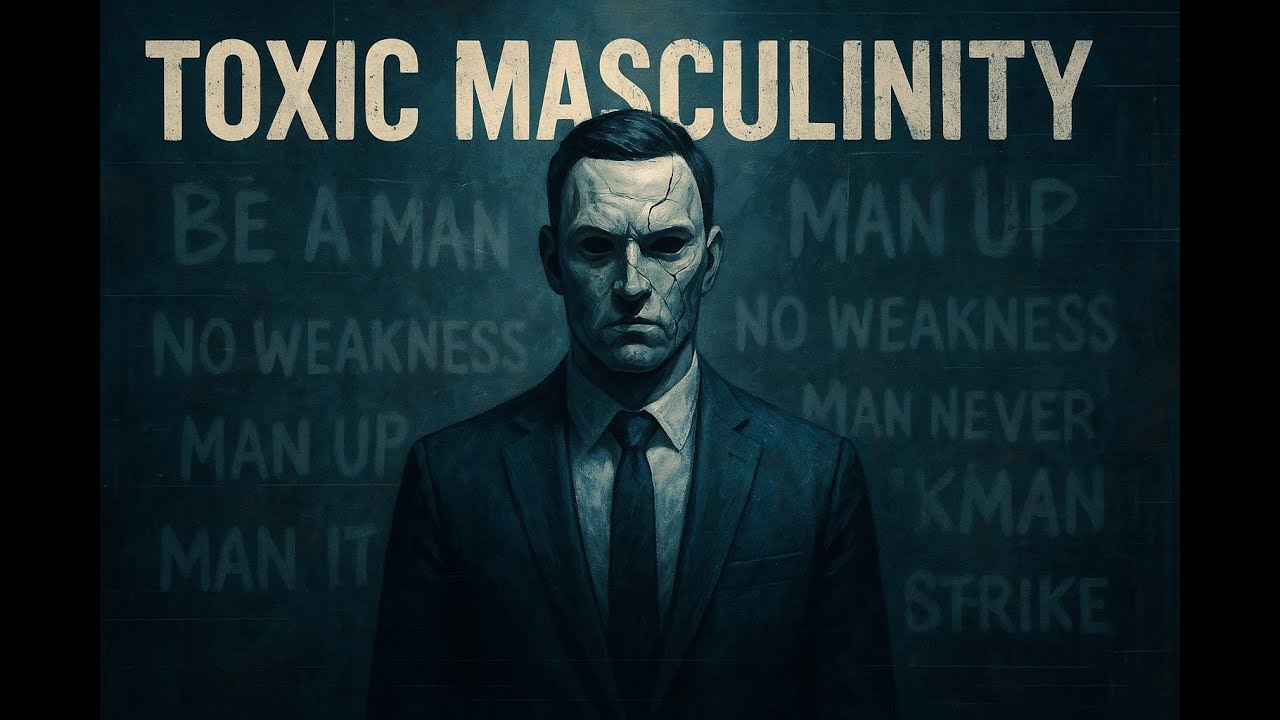
Drop your shoulders. Notice what's alive in your body right now — heat in your face, tightness in your chest, or nothing at all. Whatever shows up, let it stay, sit with it. That's step one. Let's start by deconstructing the man box, or even defining it. So, masculinity doesn't hand you a precise manual. It just hands you a box you have to fit into. Justin Baldoni coined that term.
It's a definition of masculinity that, to fit into, forces you to wage a certain type of war against yourself. You have to numb your feelings. You have to sever yourself from them. You have to ignore insecurities. You have to ignore shame. You have to put on a mask, put on a full suit of armor to protect yourself from incoming attacks. You don't get to decide what's in it. You just get punished if you don't fit.
From the moment we're little boys, the code is policed. Don't cry. Don't look weak. Don't act like a girl. And it's defined by the Brannon Masculinity Scale in 1976, which I find hilarious: no sissy stuff, be a sturdy oak, be the big wheel, and give 'em hell. It's a little outdated terminology maybe, but "no sissy stuff" — like anything that's feminine, don't do that, you don't want to do that. Again, I'm not recommending this. I am telling you what the Brannon Masculinity Scale entails: sturdy oak.
So this is the stoic front, the unperturbed man. Nothing, you know, disturbs you. The big wheel — this is focused on providing, keeping things moving forward no matter what. And give 'em hell — the competitive mindset of masculinity. I am not a fan of this masculinity scale.
And luckily, since 1976, some things have progressed. Sociologist CJ Pascoe calls it "the fag discourse." It's not about sexuality, but anything that steps out of the script. You drop a sandwich, you're a [bleep]. If you read too much, you're gay. It's vague on purpose, right? You don't know why, but suddenly you're a [bleep]. It's like, you know, the word itself is a leash.
And it's not just for [bleep] — I would say it's for all of it. You're a [bleep], you need to change your tampon — these kinds of things, right? If you are a man, you kind of know how it is in groups of toxic men. We have to deal with it, and maybe you participate. Maybe I have participated in the past. And why do we do that? The word itself is a leash. It doesn't matter what you do.
You just know that if you break the code, you'll be shamed back inside the box, because then you're not a real man, and you'll be outed from your group. And that is the one thing as humans, social creatures, that we don't want. We don't want to be ostracized. And we internalize these things very fast, right? My standards are a little different. I grew up Dutch, although I'm on the West Coast of the US right now, in Los Angeles.
So it's a different culture. I grew up with a different set of materials, but I would say that there is still a box there — the European or the Dutch box. The Dutch may have the reputation of being direct, but that reputation doesn't apply to all domains, and in my experience, rage, anger, and stoicism are as much romanticized and pushed upon boys here as in the US. My upbringing was non-standard — I would not say that I had a standard Dutch upbringing. I lost my mother very early. I lost my mother to cancer before I even turned two. You can imagine the shock that brought to myself, my family, my dad, my sister, and what the losing of that mother role did.
So to a certain extent, that made it even harder for me. You can imagine that in my life leading up to it as well — a disease like that being part of your family, that's not just something that happened overnight, it had been going on for a good amount of time before. So there was lots of stress, and of course that disconnection — that was partially because of the disease, but of course also because she eventually passed away, and everything that happened afterwards.
So it was before, and it was afterwards as well. My dad got a new partner, my stepmother, who raised me, and there is mad gratitude I have for elements of my childhood, but many moments were dark, isolating, confusing, neglectful — very neglectful — and not emotionally nurturing at all. Emotion regulation is not something that we talked about. Very stoic, very aristocratic — you know, you go downstairs to perform, put on a good face. So it was weird.
I would say that it was very compartmentalized. So a sense of vulnerability was not in the vocabulary. Whenever tough feelings were discussed, it was often a ginormous explosion that was never talked about afterwards. If you've seen Downton Abbey — somewhere I think in one of the first seasons — there's one of the lords who breaks down, cries in front of his manservant, and it felt like the same pattern. Yes, we are all human, we break down, but in the Downton Abbey world, and in my upbringing's world, things were never talked about again, which of course is a very confusing message for someone who's trying to figure out life.
There's actually sort of two lessons there. One of the lessons is that there's no lesson in emotion regulation, because before that explosive emotion occurs, you don't know what's going on. It's being repressed until it comes out, and then after it comes out, it's just a complete explosion, untethered. There's no regulation. There's no distress tolerance, to use DBT terms. So yeah, there weren't a lot of useful things that I learned there.
So I had to do all that later in life. Another important part of the man box, of course, is the domination or competitiveness — give 'em hell. As I gained more steam in life, I became more competitive. My teenage years were honestly as challenging as they come. But in my 20s, I gained some steam through a combination of luck, effort, and talent. I completed my master's degree in software engineering.
I was working in the tech field already, and in my early 20s I had a stable paycheck, I had a girlfriend, we bought an apartment, and I thought I achieved manhood — that I now could, you know, give 'em hell. That thing that I was now — where in my teenage years it wasn't as hard, maybe I tried to live out the man script more or less, but competitively I just didn't really get there. Now I was getting there. But did that change how I was handling feelings? No, I wasn't really vulnerable. I was just hiding behind a mask of stoicism. Did I self-medicate with pornography, and did that diminish the intimacy in my relationship? Yes. Did I downplay that? Everybody does that. Yes.
Did I try to exert control over whatever I could — sometimes with dieting, constricting my food intake, just to feel in control and not become skinny-fat? I've always been tall and lanky, and — although Dutch culture is different — I very much equate fat with bad, or that was the message that was taught much more there, I guess, in Europe, than here in the US. I'm not completely sure about that. But yeah, that was ironically something that really lived in my household. The funny thing is my mother was at one point overweight, so that created another one of these double standards.
So anyways, that relationship I was in actually lasted 11 years, which is great — surprising — but then it ended, partially because of the lack of vulnerability, not really connecting. I don't think that we truly knew each other deeply, for various reasons. I mean, is it my fault, is it her fault? Little column A, little column B — you know how it goes. But did I learn from that experience? Did that stop me? Did I go like, "Okay, huh, this relationship went away, should I change something?" No. I doubled down on the man box. More sexual conquest.
That's the answer. More competitiveness — you know, I was getting more ahead in life, so now I can do that. I even moved to the US, which is much more competitive. I could expand my career much more, I could work more, earn more money. Started doing more competitive athletic stuff — I'm running marathons, I did ultras, skiing, I more recently started weightlifting. And there are noble reasons for all of these things.
None of those things — I'm not saying, "Oh, don't do that because it's part of the man box." No, there's good reasons for it: anxiety management, mind-body connection, longevity. Let's be honest, though — is there a part of me that was just acting out the man script, just following what a good man does, hoping that maybe if I'm big, I'll finally be enough? So, within acting — I'm an actor.
We talk about your motivations a lot. So whenever you're looking at the script, or "slice of life," as my acting studio calls it, you often look at what the core need of the character is, and what they're masking with. Whenever I look at my life, whenever I do a thing or something like that, I do have to admit that often the core need that I have is being enough.
If I have a really good podcast, maybe I'll be enough. I try to make fun of it, although there is of course a part where some of the drive comes from that — you've got to transmute that in a certain way as well. Anyways, more about competition. Competition trains you in a certain kind of disconnection as well. It's don't feel, dominate. Even if we're talking about doing something well at work, or on social media, or whatever, it's not necessarily about feeling your feelings.
It's about getting the numbers, getting the six-figure salary, or getting the following or the engagement that you want. It's all very much geared toward numbers. Sociologist Michael Messner calls it a system of failure, though. For every kid crowned a star athlete — and this of course applies to an influencer, or a corporate structure, or something like that — there's one star, and a hundred others walk away believing they're mediocre, invisible, or not man enough.
So they're living out the man script, but they're not getting ahead enough, which is sad. The box is relentless. A provider identity — that's another big part of it, right? The big wheel. Solving problems, making money, measuring your worth in numbers. I certainly lived this script, until the flip side hit. If I'm only worth what I produce, and if I stop producing, does that mean that I become worthless?
Is my self-worth relying on the production that I do? That's not a strength. That traps you, right? Because that means you can never let that go. Let's connect it to DBT real quick. I talk about DBT a lot. Marsha Linehan talks a lot about effectiveness as a core skill that sort of precipitates through the entirety of DBT. And here, effectiveness is not what feels masculine, not what protects your ego as a man, but what actually works in line with your values.
Effectiveness often asks: what's the objective here? What's the relationship that I want to keep? What is the self-respect that I want to make sure doesn't get tarnished? If the goal is connection — if you have an objective of dominating, of winning — it won't work. If you really go into that domination mindset, check this for yourself. Think about that.
Think about even some of the movies you've watched — I don't know, cowboy men or whatever — think of a good example of a typical role model of a man, this sturdy character who doesn't get disturbed by anything, etc., etc. Are they doing really well in connection? Is that something that's being displayed? They're loners. They're loners. If the goal is self-worth, then reducing yourself to provider — that won't work either.
Effectiveness is cutting through the noise of "real men do this," and asking: does this action move me toward the life that I want, or just deeper into the box? In other words, what are my values? Because if you don't think about that, the values are whatever the man box hands down to you. You're just trying to fit into it. You're trying to not be [bleep] or gay or [bleep] or whatever.
These kinds of things — you're trying to people-please to a certain extent. But have you thought about what the cost is of staying in that man box? Okay, you get some perks. It is very clear that there are perks — that's being advertised everywhere. More about that later. But what's the cost? And does it bring you true happiness? Is it authentic?
These are rhetorical questions. The answer is no. No, it's a myth. It's a myth, I'm sorry to break it to you. So let me put it to you: when you think about your own story, what is your box made of? Is it sports? Is it the paycheck? Is it the armor of "I'm fine, I don't have feelings"? Or did you just completely give up, and are you into red pill?
And a harder question here: what have you cut off to stay there? Because the cost of this box is high. I'll say it again — the cost of the box is high. You don't just lose tenderness, or creativity, or openness. You lose yourself. And then you call it being mature, or a real man. This is [bleep]. So the man box sells you some kind of safety, but it costs you your soul.
You're not living your authentic life. You're not connecting. Cool — well, not so cool, actually. Let's move on. Let's talk about porn. So if the man box is the programming, then porn is the classroom. This is the patriarchal promise. This is man heaven. Studies show, though, that nearly 90% of mainstream porn scenes include aggression towards women. Not negotiation, not intimacy, not connection — aggression. And what you grow up with, you mistake for sex, and worse, for something you want and that's good for us.
Like red meat, and smoking, and not talking about feelings, and drinking excessive alcohol — like all these things that a stoic man does — just jackhammering different types of hot bodies that may or may not have a person attached to them. And while we're at it, same goes for the male actors. Think about it — how often do you see the face of the male actor in mainstream porn?
I am not beyond that — or "beyond" is not the right term. For me, porn was a huge comfort blanket. Although Dutch culture told me that sex should be about love and connection — Dutch culture is actually one of the more forward cultures where this is something that's talked about a lot, where it's more normal to have sleepovers with your partner when you're still teenagers, instead of having to do it in the backseat of a car somewhere.
So that's great about the culture I grew up in. But separate from that message of love and connection, hidden away, I absorbed the patriarchal promise in porn, because I was exposed to it very early, and it brought me a certain emotional soothing. And guess what happens in the videos — the girl in the video never says no. So it's risk-free. It's risk-free.
You don't have to do the work, and you get what you want. As my use of porn got deeper, my relationships with people got shallower and less vulnerable. There was more hidden shame, and it left me in this split state, till a number of years ago I joined a men's group and committed to actually doing the real work, versus just going for the cheap coping mechanism with lots of harmful side effects. Now let me pause here again — that was the case for me. That doesn't mean that it's the case for you, right?
I'm not hating on this necessarily, although there's of course ethical objections — but there's ethical objections to lots of things in life. So what did I switch it out for? And this actually was a lot of work. If you just have a coping mechanism and you're trying to find more healthy coping mechanisms, it's a [bleep] ton of work. I started relying on community — more community for oxytocin, high-intensity interval training, weightlifting, cardio for dopamine, serotonin, and cortisol reduction.
See my episode about the feel-good molecules, where I talk about this in detail. You want to have expensive dopamine, not the cheap dopamine, by just grabbing your phone and going to Pornhub, and you get instant dopamine, or Instagram, or whatever, any of these dopamine mills, right? You want to use the dopamine for what it's actually meant for — to give you the motivation to do something hard, to work for something, and you get rewarded by dopamine before you get the actual reward, which may take many hours or days or years.
So even now, we're three years later, where I haven't used any adult media, and I haven't been isolating myself with that — there are still echoes that remain. This script remains a little, and the lines are blurred. There are still elements that are seductive of this patriarchal promise, where the girl never says no. And then we have hookup culture, which just amplifies the script — also very seductive to me.
Honestly, in theory, hookups are emotionless. But the research shows, of course, that during hookups there's a huge orgasm gap. And it just comes down to — there's not as much enjoyment as the script sells you. It's even so in some of the research, in the books that I read, that it's become the default, where both partners assume that the other doesn't want a relationship — but that's not even really true.
It's just the default that's being pushed right now, because that's what we're seeing everywhere. And then we have alcohol, which makes it messier — of course also very associated with masculinity. You eat red meat, you drink, no matter what time of day it is. So you party, there's blackouts, there's gray areas of consent. I stopped drinking in 2017. One of the reasons being that I'm not a stranger to any of those things.
We have a standard — don't rape — but no training in actual sexual ethics, no training in mutual pleasure. Instead, I recommend participating mindfully with what you're doing, actually being present with the person in front of you — interesting slip up. Isn't it interesting that our default is not that? Or maybe it is your default, and then that's wonderful. But I don't believe, based on the reading that I've done, that it is the default.
There's not a lot of presence. There's performance there, and that's partially because pornography trains disconnection — I would even say dissociation — and mindfulness trains connection. So that's actually quite different. So it's my own reflection, more reflections later, but I think that there's a big patriarchal lie, that sexual conquest is something that's desirable, and once you get that, you have all the power and the money.
Does it remind you of Epstein vibes? Anyone? So what do you actually want? What is good for you in this context? Am I selling you some kind of "stay a virgin until marriage" thing? No, absolutely not. Connection and enthusiastic consent — it does not mean vanilla. I am not a vanilla guy. Go to Burning Man. Go have yourself a threesome. Go to a play or sex party.
Buy a chest full of toys. Have as much sex as your heart desires, with anyone you actually know — not a parasocial relationship, where you're texting some kind of OnlyFans model, and of course some social media manager is replying to your messages, not the person themselves. Parasocial relationship being a relationship with someone you don't actually know, but you feel you have a relationship with them.
This happens a lot with celebrities — like, do you feel like you know Brad Pitt, what he's about? I kind of do — I have a little bit of a parasocial relationship, because of all the things that you know about these people. So I am not here to tell you to be a prude. Not at all. But I am telling you to communicate and be vulnerable.
Can you talk about sex? Can you ask your partner what they like most, even during a hookup or casual connection? Can you talk about what you like? Can you honestly have that conversation? For my supposedly liberal Dutch upbringing, I am not the best at it. You know, isn't that funny? You can do it, everybody does it, but you can't talk about it. What the [bleep] is that about?
bell hooks wrote the book "The Will to Change." She reminds us that patriarchal sex — that's all part of the man script — is about domination. So there's always a top and there's always a bottom. And I'm not saying that there's anything wrong with having power dynamics in sexual play — that's also not the point here. But the point is to not see this as a game of domination.
All right, so instead of dominating, think first about how you can give, how you can connect — not what you can get, or what you can get away with, or how you can do as little as possible, how you can game the situation. This is a message I take to heart, because sex without presence just becomes performative. So in your next intimate moment, notice if you're chasing ego or if you're chasing connection, then choose to give, not get.
Let me talk about red pill and hypergamy a little as well. This is an episode by itself, but a friend of mine — I was talking to Tim about this — said, if you're talking about toxic masculinity, you have to talk about red pill. I was like, "Okay, well, there's a point there." Because if porn is the classroom, then red pill ideology is kind of like the graduation speech.
It takes patriarchy but refuses to play. It does not transcend that — it's still within the script of patriarchy, but it's like the self-chosen loser, where it's like, "Oh, I don't fit in the man box, because I don't have broad shoulders, or a square jaw, or I'm not tall," whatever the reason is. And then it projects all of those problems outwards. So it's the chosen loser in the same rat race.
It takes all the insecurity, the silence, the orgasm gap, the lack of education, and codifies it into a beautiful little worldview. Red pill tells boys and men: women are hypergamous, they will always trade up, they will never be satisfied, they will cheat and leave the moment a better option comes along. So your only chance is to dominate, or you will be dominated. You will end up in a situation where you can't get a partner.
Well, that is not intimacy. It's paranoia dressed as philosophy, where there's like some kind of logical kernel of truth to it. And when I say logical kernel of truth — yes, of course, women, and I think the same applies to men, try to date at the same level or up. There are echelons in dating. But the way that I'd formulate this now, it's not even that someone is necessarily better than you because they're in a higher social class or something like that.
It's about a match, right? It doesn't mean that if I date someone who is blue collar, because I grew up blue collar, and then I date someone who has a white collar job, that they're better, that I'm dating up. That's competitive thinking. Is it a match? Are there value matches there?
So I don't think that it's the most productive to see it as a hierarchy. It's just what's familiar, and what is a match, and that comes with the context that you're in. But I get the appeal of red pill ideology. Have you been hurt, rejected, ghosted? It is super seductive to find a system that says, "See, it's not your fault.
It's female nature. It's the women's fault. It's the feminists." But what you gain in certainty, you lose in community and humanity. You stop seeing your partner as a person. You start treating her as a threat. And that's not great for your vulnerability and your connection. Let's talk about covert depression for a bit. Because the cost of this armor, this man box situation, isn't just bad sex — it's pain, male pain in general.
The script we get seems to imply that we can just be in our manosphere, have power, have money, have sex, do a little bit of raising a family — sort of like, you know, in a shop window, while you're cheating your ass off behind the curtains in the back — and then you win. This is basically, if we look at some of the richest people or the most powerful people in the world, that's how it is — look at Epstein, etc., etc., or the freak-out parties, you know. It shouldn't be that much of a surprise that this is something that corrupts you — you're doing things because they seem seductive in the short term, and because you have access to them.
I think in some of these kinds of parties and whatever, it's not even necessarily that people want that, but they feel that that's what comes with the territory, and that's the lie. The lie is that we can just bury the [bleep] up [bleep] that happened to us, and just be competitive, do the things with the big wheel, and follow that script dogmatically, and then we'll be okay.
We will not be okay. We will be what therapist Terry Real calls "covert depressed." This is much more what he sees in men — not the overt depression of sadness, it more looks like numbness. You're numbing yourself with something, and that can be work — so workaholism. It can be addiction. It can be rage. It can be whatever. For me, I think it looked like overwork — workaholism, grinding out more hours, convincing myself that I was providing and that that was a good thing.
And these "crush the competition" mantras — anything but actually being present. How hard is it to sit still and meditate? How hard is it to sit still for an hour on your couch? It's like one of the hardest things in the world for me — in silence, right, not watching Netflix or whatever, but meditating, being present. It's so much easier to just go to work and punch the clock and be a wage slave.
Not that — again, I am also a wage slave. There's nothing wrong with being a wage slave, but it's also good to realize what rat race you're part of. So anything but sitting still with my own grief — that would be easier — which, by the way, is the antidote to male depression, the covert male depression, as Terry Real talks about it. This is one of the big lessons, and this isn't just from the research for this episode, this is what I learned from my own experience, because I went through all the [bleep] that I went through in my earlier years.
Then I picked up steam in my 20s, and in my 20s and 30s to a certain extent as well. I really believed that if I could just follow that dogma, follow that — success is another great way that you can frame that within the man box. Think of someone who takes success, but disconnected from truth, to an extreme degree, and you have President Trump, for example — it's all about the narrative.
It's all about being successful, and he doesn't give a [bleep] about what's true. He doesn't give a [bleep] about what he's saying, like if he's going to say something different the next — no, he just cares about being successful. And you see that some people see that as a good thing — to just be unapologetically focused on success and, you know, death otherwise — what's the phrase, "live free or die"? "Success or die" or something like that — "success, and the consequences be damned" was really the expression I was looking for. And that is a way to live that gets you respect from some people who are in the pyramid scheme of toxic masculinity, right?
Because it is not without its spoils. It does give certain perks. The perks we see around us all the time — that's what's being marketed, that this is how it is, being part of a multi-level marketing scheme. You don't start participating in a multi-level marketing scheme without someone constantly telling you, "Hey, if you get to this level, you get these perks, and these perks, and you get this for free, and that for free" — if you only sell — this is the same thing.
It's the same thing. If you keep climbing every level that you climb in the toxic masculinity pyramid, you get a couple more perks, but you're selling your soul as part of that. None of it is authentic — I shouldn't say none of it is authentic, but generally, when you're in one of these races — and we do it all the time in various different things, important and unimportant — you're not really connecting it to your values.
You're just connecting it to the dogma. Am I being a good little boy, and following the dogma? Am I getting to level 68 masculinity, so that I get some extra spoils — some extra sex, some extra money, some extra respect, some extra, you know? So the alternative is actually thinking about these things, and actually processing and talking about your grief. Oh my god.
Talking about feelings — no sissy stuff, Vincent. No sissy stuff. I'm not going to talk about my feelings. I don't even have feelings. I don't know what you're talking about. I'm fine. I'm fine. I don't want to talk about that. That's the name of Terry Real's book — "I Don't Want to Talk About It." How great of a title is that? But it's the only way of moving through it — to actually, as Brené Brown calls it, "call truth to bullshit." Even if you're bullshitting yourself, the most powerful bullshit is the bullshit you serve yourself.
Don't forget that. And sometimes what is really important is to come to terms with the fact that something that happened to you was messed up. That was messed up, that that happened. There is no justifying that. Caregivers dropped the ball. Really dropped the ball on that. And instead of internalizing that as, "that's kind of how the world works" — thinking of examples in Terry Real's books, where men grow up with their dad beating them mercilessly, and instead of really thinking about that, it gets internalized into, "oh yeah, but that's kind of what you do," and then you repeat it, because you're really sad about that, actually.
You know in your heart that it's not right, but you can't admit that to yourself, and then you just end up perpetuating the cycle. And what's hard about the situation is, when we're talking about the man box, it's not just stuff that we do to ourselves. It is even us as men — it is also enforced by patriarchal women, because women also get substantially less, but get something from the patriarchy from playing the system, whenever there's a powerful system in play.
Yes, you get little handouts for being a good little boy and playing along. This is what society is. And then there's generally a large base that is just being ripped off mercilessly. But if you're a couple of levels higher, you get a little hand-up of whatever is being funneled up to the top. This is starting to sound really tinfoil-hat, but I don't think it's that mind-blowing, all of this, right?
This is just kind of how late-stage capitalism sort of works. But let's not go into that too much — I'm not here to hate on late-stage capitalism, because I don't have a good suggestion for what to do instead. So, future episode. But when it comes to patriarchal women, what bell hooks notices is that it is actually really hard to give men compassion when they are expressing feelings, because men already get so much, and now we have to give them compassion too?
No, shut the [bleep] up, protect me — like, that's — I don't want to do that. So that's another component. How about the friendship crisis? Liz Plank points out that millions of men report having zero close friends, and Niobe Way found boys at age 10 describing deep friendships, but by 14 they shut it all down. And why? Fear of being seen as weak, or worse, gay, or [bleep], or whatever.
Because cultivating relationships is something that classically women are better at. The men get some kind of result, do some competition, and women have connection. So guess what — men end up profoundly alone. What's hard about the situation of toxic masculinity is, often you're in a situation where the only person who can help you along is your partner, which, you know, in a heterosexual couple, is generally a woman.
So that makes it even more complicated — that upsets the entire apple cart as well. And if that relationship goes away, or even within that relationship, you can get incredibly lonely. And loneliness is actually something that kills. It's one of the strongest predictors of suicide in middle-aged men. So it's super, super, super important to have a support network, which I do. And one of the things that I realized through the research that I did is how grateful I am for that.
And not just grateful — it's work. I invest in that network every single week, a couple of hours, maybe two or three hours, because I have calls, I have conversations, I stay in touch with people — [bleep] stuff, in a way, because it's connections, right? But that means that if I go through something that's very tough on me, and I have some complicated feelings, if I'm in a relationship, I don't just have the one person that I can go to and dump all that stuff on.
No, I have multiple people that I can choose from, not one friend that I always call, whatever. But that's something that you need to invest in, and nobody tells you that. I believe nobody taught me that. This is not a message that I got from my family. Heck no. Body image — also, one interesting one. Justin Baldoni talks about obsessing over wide shoulders after a Men's Health article.
And I get it. I've trained for over a decade after not training — it's been almost, I guess, 20 years. I started running again when I was like 31. And I do that partially for longevity and for mental health — this stuff is very important — and aesthetics, sure, partially for validation as well. So, but it's important to realize that if you're trying to live up to masculinity through some kind of blueprint, it sells you a mirror that you can never fill, and body dysmorphia will just be your companion.
I actually had a conversation with an acquaintance of mine, who has been lifting semi-professionally, or really consistently, for over 20 years. He's a tall guy, he's big. Tall guys tend to have a little bit of a harder time putting on weight, but he's big. And he confided in me at one point, and said, "No, but already 10 years ago, a doctor told me I have body dysmorphia."
And I didn't believe him at the time. And over time, he does believe it now, because of how he sees himself in the mirror. He still sees himself as a scrawny, tall kid. And I can understand — I can understand how that works. I am fortunate to be able to say that I don't have body dysmorphia. But what I do have is that it depends very much on my mood, how the guy in the mirror looks, right?
It depends on the news that I've just had, and my perception of myself can be completely different. Maybe I do have body dysmorphia, but I can manage it pretty well. I don't know. How about workaholism? If you remember Brooke and Gary from my last episode — that scene from the feature film "The Break-Up," featuring Gary — he's arguing because he works a lot, and he should just be let off the hook for being present and attentive at home.
Does that sound familiar? I have been super guilty of that. And it's a myth often talked about in my therapy group as well. Yes, as a man — or not just as a man, but oftentimes when you're a man — the default is that you provide. Yes, but let's be honest — would you work regardless of your relationship? And is working really just an escape? It's like an escape into the manosphere, because work tends to be a place where you can just go, and you don't feel like your boss is going to — well, maybe they're going to ask you, "How are you?" or some kind of surface-level [bleep], "How was your weekend?"
But they really just want to — they do that so that they can move into the next order of business. I don't want to have like a deep sharing session with — that, it's pretty rare. It's pretty rare that it goes to that level, and there tends to not be a lot of complicated emotions in the male workplace. Maybe you get angry and you yell at one of your coworkers or something like that.
That's somewhat acceptable, and that happens, you know, but it's not very challenging. It's very comfortable — tends to be very comfortable, and sometimes that means that you're just hiding. Sometimes it's just another addiction, something that you do so that you don't have to deal with the things you should actually be dealing with. Cool. So let's talk about the path forward. We've torn it down — the entire man box, the porn script, the hidden pain, red pill. So now what?
We can't stop at critique, right? So we need a path forward. And I guess I'd also reiterate that I used to think about this topic more as a dogma — like there was a dichotomy where you have the classic man, which is like the big wheel and the sturdy oak and whatever. But that's a crude stereotype. There's another stereotype, and that's more the stereotype that I lean toward, because I just, you know, happened to be — how do I say that without it sounding pretentious? It's probably just going to sound pretentious.
But growing up, one of the things that was of utmost importance was academic prowess. I don't think it was ever considered for us to not go to a grammar school — which probably is a Dutch thing — but it's one of the schools where you still get taught ancient Latin, and that comes with a certain level of elitism. "Really? Oh, I had Latin in school. Okay, wow." I don't know what that was — I think it was something with my pinky up and drinking tea. It turned into a Dr. Evil thing.
I don't know what the [bleep] I'm doing, it's all good. But that did lead into — I wasn't necessarily as focused on athletic performance or something like that. That was not really something that we did as a family. We just talked a lot. So to this day, the primary way that I use to connect, or identify, is talking.
I just realize how ironic it is, me saying that on a podcast, because yes, here I am, being a talking head, just talking. But yes, this is one of the things I do. I can think about all these different concepts really well and talk about them in a certain way. So I thought about these as two different stereotypes, but they're both man boxes in a way.
It's not that the academic man is completely divorced from that other type of man — they're sort of related. And I thought of it, still, in a little bit of a way, as a hierarchy — how interesting that is, that sometimes, because I kind of was born into the one box, that was just the thing that was handed to me, the culture that I grew up with, but I still, at times, have a relationship with that other man box, the ones that you see in the movies, where there was something to be achieved there. And that's the reason, I think, partially as well,
that I started going more into the athletic or competitive man box — because as the academic archetype, you can absolutely provide, right? You can make a six-figure paycheck, no problem, that's great, if you go into that field, especially if you're in STEM or something like that. So that's all wonderful. But there's something really interesting, as
I started tearing both of them down — because in a way, the academic man, the slightly more feminine man, felt like something more evolved, in a way, or should I say "woke," I don't know — but that by itself becomes a kind of trap. Because it's related to something I talk about further down, but
I'll talk about it now.
There's something in nature that I learned about at one point that's called a "sneaky [bleep]." That happens, for example, with orangutans and sea lions, where being a man and having a harem is the primary way of doing it — that's the way the society is structured. But then there are males that sneak into the orangutan world.
There are males that actually look like females — they're a feminized male, but they can still sneak into the group, and then procreate, and just not deal with all of the work that it takes to be a "real" male. And that's very much a naturalistic fallacy — I know, if you look at nature and then say, "Oh, that now applies to society," it does not.
But it's an interesting concept. It's an interesting concept when you use the fact that you're not that brute, like that bigger orangutan or sea lion, who is always fighting because that's what he needs to do to stay in control of his harem, so that no stronger male gets it. So if you then position yourself as, "Okay, I'm this more well-rounded, feminine type, and I think about things and whatever" —
but if you use that just to get an advantage, and then to do the same thing that the masculine man does — just to try to make that a way to get into women's pants — that's what a "sneaky [bleep]" is. And you're just pretending to be a feminist. You're fronting, giving the facade of being this and that, and whatever,
but then when push comes to shove, you're kind of doing the same thing. You're still on the same pyramid. You're still trying to get the same rewards, but in a roundabout, different way. No — that's also a man box. It's a slightly different man box, but it's still a definition of masculinity where you're using deception. It's not authentic.
Sometimes these things get really, really complicated, because sometimes you have to dig really deep and reflect really deeply to take a look at what am I truly, honestly doing. Do you know this principle, that sometimes you can have two different intentions with the exact same actions that you do, the exact same words that you speak, but if your intention is different, in the eyes of the universe, it is different?
Can you recognize that? And can you also recognize how incredibly hard that is? Because you can't really see that from the outside. Maybe if you're a psychologist, and you analyze someone really well, on a video, or you listen exactly to what they do, maybe you can suss it out, but it's really subtle. Yet the intention makes a difference, right, because short-term you might get the same result, but the intention, long-term, of course, changes it.
So this all boils down to un-defining masculinity completely, in the sense of loosening this entire armor, so something real can breathe. And that gets to nihilism — remember my episode about nihilism — that sometimes it's really, really important to tear all of these structures down, to really see, okay, well, the academic man is a myth. It's a concept. The competitive man, or the aggressive one, or whatever, however you want to name them — they're all concepts, they're all models of interacting with reality, and it doesn't really matter which one you pick, if you follow it dogmatically — it doesn't matter. There's no essential difference, really, between choosing the script of a competitive man or an academic man. I've switched a little bit — I used to be really identified, because that's how I was brought up, with intelligence.
So what was very important for me was that whenever I would walk into a room, it would be known that I was quite intelligent, what have you. And the interesting thing is that, of course, that element is still present, but it's just kind of like what I was fed with the oatmeal spoon, as they say in Dutch.
It's just my upbringing that got handed to me, that's the way that I communicate and talk to people, to a certain extent. You can't completely revert it — it's now sort of part of me. I'm an academic person, and I like knowledge, and I am bookish, and all these different things, and yes, I can reason pretty well as well.
That's — I don't — it's not as important to me anymore. I won't be snubbed now if someone thinks that I'm stupid, or doesn't know that I'm intelligent, or something along those lines. And I also know that there are many limits to that. I have a certain type of intelligence, but there are many types of intelligences.
I happen to be pretty good at reasoning, abstracting, etc. But I'm not really good at facts or something like that. If I go to bar trivia, you can sweep the floor with me. I'm useless there. There's a little Dutch expression for you — "sweep the floor with me." I'm not competitive in that sense.
So, yeah. As I started to go more from using words and intelligence towards being really identified with athletic achievements — because I started running a lot, doing ultras, and weightlifting — and knowing a lot, now I have a lot of body intelligence, right? Whereas at first, in the earlier parts of my life — do you know this concept, where you just don't really have that much body awareness — and one of the cool things about running, lifting weights, whatever, is your connection with your body just becomes better, so that your body is not just a vessel for your brain or something like that, which is missing the point.
I think the entire thing needs to be integrated. So as that changed, some of how that fit into the man script also changed, right? Because now, from an athletic perspective, I can stand my ground a lot better than, I don't know, 20 years ago or something like that. That would have been no point in really trying to do that.
I could hike pretty well, and I ate pretty decently. I actually was raised with really good nutritional standards. So that's just something I got for free, which is actually really nice, to know how to feed yourself properly, and that you're not just eating McDonald's all the time. But anyways, I super digress. It's all about the nihilism.
The point is that there are all kinds of man boxes that you can define. There's not just the one man box. I would say that they all roll up into structures anyway, and you need to break that [bleep] down. Whatever the [bleep] is for you — no matter if you're on the academic side, or maybe you're on the creative side, or maybe you're on the athletic side — it doesn't matter.
Ultimately, these things need to be torn down, and what needs to be built up is something that is related to your own values. And of course, the values are still interconnected to your upbringing, but at least you're being honest. It's not a dogmatic following. It's more like, these are the elements that I choose. And I know everything is arbitrary, so there's not one thing that's better than another thing, from an absolute perspective.
You can't claim from an absolute perspective — you don't know, and it doesn't matter, right? So within the relative field, we can still make choices. So these are the choices that I'm making. This is what I find important. And within that context, I would say when it comes to being a man, masculinity, or something like that, shifting from a "what can I get" to a "what can I give" perspective.
What can I get? Think of Donald Trump. Donald Trump asks continuously, "What can I get? I want a ballroom. What can I get? What can I get?" Sure, there's some veneer around it, and I don't want to get political — but, sorry, it's just such a poignant example. Do you think that Donald Trump really asks, "What can I give?" He talks about that, but do I get the impression that that's something he wakes up and — no.
It's not something that I think he actually values. And what I'm presenting to you is that a lot more satisfaction, happiness, and meaning in your life can come from going in that direction — from "what can I get, how can I cheat the system, how can I get into the pants of this woman" to "what can I give, what's actually the thing that I can provide?"
And provide in a way — not in this narrow "provide" way, like pay — but in a broader sense. Sometimes if I'm talking about providing and giving or something like that, you can get into a resentment mode, because if you only give and give and never get back, that's not really what I'm trying to say. What I'm trying to say is that,
in this world, by and large, for most people, especially men, you automatically already think about what you can get — enough as it is. You don't have to double down on that, that will take care of itself. So it's all about doing that in a conscious sense. It doesn't mean that you're going in the direction of people-pleasing. It's, what can I give,
like, give with a capital G. It's how can I move things, what can I give in line with the values that I have — not like, can I give a sandwich to that guy over here and money to that woman over there. No, it's more like, what am I here on the planet to provide, what's my unique gift,
or what are my unique values, what can I provide. Yeah, I don't know why I feel that — that doesn't explain it well enough.
Maybe it does, maybe it doesn't, who knows. Because a lot of male socialization centers on acquisition, status, money, sex, dominance, success, right? The pivot is service and reciprocity. Ask it everywhere — at work, at the gym, in bed, to yourself. To yourself — when you're meditating, ask it to yourself. Don't just give to others. Give counterintuitively. What can I give to myself as well, to my higher self, something that I'm thinking in the direction of growing? Like, how can I invest in myself, how can I give in a way that creates connection, not martyrdom — contribution. So I think that's important.
I have a couple of smaller things that are also important, that I took away after ingesting all of these things. I think language matters. I have decided to dial down the "crush, kill, destroy" metaphors. I also have a corporate job, and that's often used — "he killed it at this meeting," blah, blah, blah, blah, blah. I've decided to stop. I will use "excelled," "showed up," "led well." I'll drop [bleep] for "punch" — that's — I don't have anything against dropping f-bombs, but not when that's the oxygen of your identity. And to repeat, a little bit of a repetition — I went a little off script there.
Assume less, connect more. Find connection in classic toxic male settings. Don't assume that there's going to be no connection, and no one willing to engage in vulnerable sharing, because interestingly enough, we are regressing, and also we're moving forward, like, right, with the whole political situation here in the United States — obviously we're turning the clock back to the '60s, or some people are trying that — but interestingly, as a counter-movement, there is a counter-movement that reacts to that force with equal force in the other direction.
So even if it's a classic setting, like a sales dinner with tech bros, stay curious, and name what you appreciate. Ask the real question that you're afraid to ask. I have a new thing that I'm doing — I have, on my — I like lists, I've talked about this in my feel-good molecules episode — keeping to-do lists, so that you get a little dopamine when you check something off.
And I have a recurring one, where every day I have one that says, "Do the thing you don't want to do." This is another example: ask a question you're afraid to ask. That can be the thing you don't want to do. I am a fan of athletic performance — I love running, weightlifting, climbing, all of these things, it's wonderful.
Biking — I do it, I intend to, I'll keep doing it with gusto, although it is part of the man script. It happens to be something where we overlap. So I do it for longevity. I do it for presence. I do it for the mental health benefits. I do it for aesthetic reasons as well. But the focus is tracking on how I feel. How do I sleep?
How is my mood? How's my patience — more than ego-lifting. Did I run faster? Did I lift more weight? Did I do more reps? Did I gain muscle mass? Did I lose body fat? All these things are secondary. And of course, redefining sexual norms — holding enthusiastic consent and mutual pleasure as the standard. And for me, that's open conversation, sober choices — and I don't mean not drinking alcohol, although I don't mean not drinking alcohol either — but love with lust.
No prude perspective here. Just, interestingly enough, in this whole movement of me dealing with my porn use and the shame around that, the interesting thing on the other side of it, now that it's so much easier for me to talk about that, is that I'm actually feeling much more open to being more explorative in that sense. Instead — I would have expected that that would have resulted in me sort of calming down, because porn was this wild thing where you do weird stuff, and you can get weird stuff on the internet.
We all know that. So I thought that if I could shut that down, that things would look very different, more vanilla. But the reverse is true, right — of course, because that interest is in myself. The important thing is to do it in a way that it's in line with connection, and with the real person. For the rest, like — that expression is wonderful.
That's why I'm really underlining, do all the freaky things. Do your kinky stuff. Go to sex parties. Go to Burning Man and have a threesome. I think all of these things are wonderful if that is something that you're authentically interested in — not because that is a hallmark of being a real man, or some [bleep] like that. If that's really something that gives you the — as my acting teacher calls it — "go for it."
And don't let yourself be stopped by shame, counterintuitively. Let's see, am I going to talk about that? Sure — dual control model. I don't know why I have that here exactly, but this is by Emily Nagoski. I love Emily Nagoski. Sex educator, wrote a bunch of books. In her model, she talks about accelerators and brakes, and arousal non-concordance, which means that you can't let your genitals tell you if you want sex.
If your dick's hard, or your vagina is wet, that doesn't mean you want sex. It's just your body responding to some stimuli that your body feels is appropriate, but that doesn't mean that your words say yes and your genitals say yes, or no — that's not how that works. That's what she talks about a lot. And also, what makes it very important is to translate that into practice, and to talk to your partner.
What are their brakes? What are their accelerators? Ask, listen, adjust. Have the conversation about that. I don't know, that's important. I wish I'd started doing that way, way earlier in life. And that's scary, and it's vulnerable. It's much easier to just do stuff and not talk about it. And believe me, it's much, much, much easier to just lock yourself in the closet on a Friday night and find it on the internet.
That's the easiest thing in the world. Bringing it out into the real world — now, that's much more important. Let that part of you have a seat at the table. Don't lock it up in the closet. That's what I would say there. And push back on the "real man" story, without turning it into a ruse — like I said, no sneaky [bleep] energy, that subtle self-betrayal where you tell yourself you're being mindful, chill, feminist, pro-women, or just going with the flow, but deep down you know you're manipulating the situation to get your emotional hit.
Sex, control, validation, attention, success, whatever your drug of choice is. It's the unconscious hustle of the ego, wearing a spiritual hoodie, pretending to be calm while it's actually scheming. You know when you're doing it — don't [bleep] around, don't do that. Be honest with yourself. Don't perform sensitivity as a tactic to still get dominance. Drop the hustle for approval. Avoid dogma. I've said that in multiple different ways.
The whole man box, the whole patriarchal, whatever — that is dogma. It's your job to lead with intention. Going straight against the man box is not what I'm talking about — that's still, you know, you're still eating the dogma. You can become a red-piller in that way. So it doesn't work like that. You can't just take an existing dogma and do the exact opposite. You have to think about your exact intentions.
You have to think about your values. Rules help until they don't. I'm not saying that dogma is evil, and it's never useful, but you get to one point — at one point in life, you have to know that dogma doesn't get you there. It's not a rule book that you can just follow, and it will cover everything. It's more like a framework that, as you become sufficient, or become more effective in life, you follow, and then you have to throw the rules away.
I don't know why it works like that, but it does. Notice when your rule-following becomes control. It still happens to me every day. I'm not beyond this at all — that's not the right word, "beyond." I'm not — there's another word, like "superior" to that. Anyways, keep thinking for yourself, boys and girls. Karma — I must have talked about this before — karma as doing.
Karma is not cosmic punishment. It's what's to be done, what's on the slate for you. You burn through your actions, and you reflect on that. So that means that you don't have to be perfect. You just have to own your [bleep] and do better than the last iteration. That iteration can be last week. That iteration can be a past life, if that's how you like to think about it.
I don't give a [bleep]. That doesn't matter, as long as you're engaging with that feedback loop, being sure of what you're learning. And the takeaway is, you don't have to be perfect. The entire act of self-actualization is burning through karma. You have to go through all these different stages. So don't hate on yourself for not doing it right the first time. I surely don't. I [bleep] up all the time.
So that's today's journey — from the crammed walls of the man box, through porn scripts, hookup culture, into the loneliness beneath the armor, finally towards a masculinity that doesn't need domination to feel alive. This work, I've said it before, it's not easy. It isn't instant. It's worth your whole life, because it is your whole life. You just have to notice the [bleep]. You have to question the inheritance.
You have to practice the skills that bring you back to yourself, authentically, and to the people you love. Connection — we are human, connection is incredibly important. Speaking of values, speaking of effectiveness — you can disagree with me. You can be a super introvert, and you can think that connection is whatever, I don't give a [bleep], that's true for you, wonderful.
You don't have to agree with me. But I do want you to reflect on it, to check. And it can be good to be inspired by something, right? You can be like, "Huh, that's an interesting thought that Vincent just shared, let's see if that holds up for me." Remember, performance without presence is hollow — it doesn't just come to sex. What matters isn't whether you look like a man, or provide like a man, or whatever, like a man.
What matters is whether or not you can sit down in your own skin, connect honestly with those around you, and keep choosing growth over armor. Thank you for listening to The Meaningful Sh!t Show. Now go do the work. See you next time. And this was Vincent.